Skip to content
Epomedicine

Mnemonics, Simplified Concepts & Thoughts

Epomedicine

Mnemonics, Simplified Concepts & Thoughts

Dermatomyositis skin

Skin signs of Dermatomyositis: Heliotrope rash, Grotton papules and Shawl sign

Epomedicine, Jun 19, 2015

Dermatomyositis is a connective tissue disorder characterized by chronic inflammation of voluntary muscles and skin. It is more common in women and the age of onset is 50-70 years.
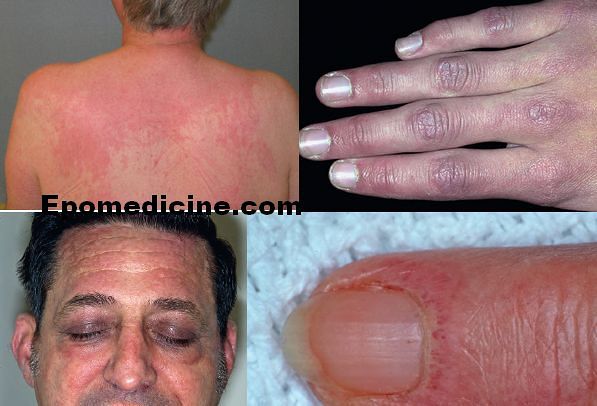
Dermatomyositis skin
A. Shawl sign B. Grotton’s papules C. Heliotrope rash D. Telangiectasia

A) Heliotrope Rash:

  • It is a macular, confluent, purple or purple/red rash over both eyelids and periorbital tissue present with or without edema.
  • Mechanism: Unclear; probably indicates inflammation of underlying striated orbicularis oculi rather than the overlying skin
  • Resembles  Heliotropium peruvianum flower, which has small purple petals.

B) Gottron’s Papules:

  • Violaceous (violet-coloured) papules on the dorsal aspect of the interphalangeal joints.
  • Mechanism: Unclear
  • Pathognomic sign

C) Shawl sign:

  • Confluent, violaceous, macular (i.e. flat with violet/purple colouring) rash over the posterior shoulders and neck.
  • Mechanism: microvascular injury by complement deposition

D) Other skin signs:

  1. Photosensitivity
  2. Pruritus
  3. Nail fold telangiectasia
  4. Scaly scalp
17 shares
  • Facebook17
  • Twitter
Clinical Skills and Approaches DermatologyInternal medicinePediatrics

Post navigation

Previous post
Next post

Related Posts

Clinical Skills and Approaches Tuning fork parts

Hearing tests with Tuning fork

May 24, 2014Jun 18, 2016

Tuning fork Parts of a tuning fork 1. Foot piece 2. Stem 3. Prongs How to use tuning fork? Hold the stem of the tuning fork between the index finger and thumb of your right hand without touching the prongs. Strike the junction of superior 1/3 and inferior 2/3 of the…

Read More
Clinical Skills and Approaches

Eliciting Primitive Neonatal Reflexes

Mar 8, 2023Mar 8, 2023

Neonatal reflexes are the reflexes which are present at birth and have a predictable course of appearance and disappearance. A normally developing newborn should respond to certain stimuli with these reflexes, which eventually become inhibited as the child matures. The list of reflexes that can be elicited in normal newborn…

Read More
Clinical Skills and Approaches knee pain

Mnemonic Based Approach to Joint Pain

Feb 19, 2022Feb 19, 2022

Step 1: Arthralgia vs Arthritis Arthralgia Arthritis Symptom Diagnosis Joint pain without inflammation Joint pain with inflammation (swelling, redness, tenderness) Articular or Non-articular Articular Articular Non-articular Pain with all joint ROMs Pain with only some joint ROMs Most painful at the limit of joint ROM May not be most painful…

Read More

Leave a Reply Cancel reply

Your email address will not be published. Required fields are marked *

This site uses Akismet to reduce spam. Learn how your comment data is processed.

Pre-clinical (Basic Sciences)

Anatomy

Biochemistry

Community medicine (PSM)

Embryology

Microbiology

Pathology

Pharmacology

Physiology

Clinical Sciences

Anesthesia

Dermatology

Emergency medicine

Forensic

Internal medicine

Gynecology & Obstetrics

Oncology

Ophthalmology

Orthopedics

Otorhinolaryngology (ENT)

Pediatrics

Psychiatry

Radiology

Surgery

RSS Ask Epomedicine

  • What to study for Clinical examination in Orthopedics?
  • What is the mechanism of AVNRT?

Epomedicine weekly

  • About Epomedicine
  • Contact Us
  • Author Guidelines
  • Submit Article
  • Editorial Board
  • USMLE
  • MRCS
  • Thesis
©2026 Epomedicine | WordPress Theme by SuperbThemes