Skip to content
Epomedicine

Mnemonics, Simplified Concepts & Thoughts

Epomedicine

Mnemonics, Simplified Concepts & Thoughts

mmse

Folstein Mini-Mental State Examination (MMSE): Mnemonic

Epomedicine, Oct 25, 2017

ORARL, 5-3-5-3-9

1. Orientation:

  • Time (5 points – 1 for each correct): What is the: (year) (season) (date) (day) (month)?
  • Place (5 points – 1 for each correct): Where are we: (state) (county) (town) (hospital) (floor)?

2. Registration: Name three objects, ask patient to repeat (3 points – 1 for each on first repetition; allow upto 6 trials)

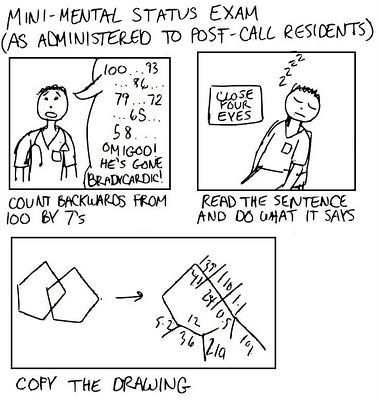
3. Attention/Calculation: Serial 7 substraction Or Spell “WORLD” backward (5 points – 1 point for each in correct order)

  • 93, 86, 79, 72, 65…….
  • D-L-R-O-W

4. Recall: Ask the patient to rename the three objects stated earlier (3 points – 1 point for each)

5. Language: 9 points
mmse

Language: 2, 3 DRaW

2 (2 points – 1 point for each) – Name 2 objects (pen and watch)

3 (3 points – 1 point for each) – Follow 3 step commands (“Take this paper from my hand, fold it in half, and drop it on the floor.”)

1 point each:

Drawing – Copy a design (Copying 2 intersecting pentagons – all 10 angles must be present and two must intersect)

Reading – Read this statement and do exactly what it says (“Close your eyes”)

Repeating (Allow only 1 trial) – Repeat the phrase “No ifs, and or, buts”

Writing – Write a sentence (must contain subject, verb and must make sense; correct grammar and punctuation is not necessary)

Interpretation

  • 24-30: Normal range
  • 18-23: Mild cognitive impairment
  • 0-17: Severe cognitive impairment
20 shares
  • Facebook20
  • Twitter
Clinical Skills and Approaches Clinical examinationNervous systemPsychiatry

Post navigation

Previous post
Next post

Related Posts

Clinical Skills and Approaches knee ligament examination

Tests for Knee Ligaments

Oct 29, 2017Sep 3, 2020

Anterior Cruciate Ligament (ACL) Lacchman’s test It is performed with the patient supine and the knee flexed 20–30°. The examiner grasps the distal femur (from lateral side) with one hand and the proximal tibia with the other hand (from medial side). The lower leg is given a brisk forward tug…

Read More
Clinical Skills and Approaches

Hoffmann’s Sign

Dec 7, 2022Dec 7, 2022

History Method of Eliciting Hoffmann’s Reflex Mechanism of Positive Hoffmann’s Reflex Sudden stretch of the finger flexors causes involuntary finger flexor contraction due to activation of a monosynaptic stretch reflex. Exaggeration of the reflex is caused by hyperreflexia in the setting of upper motor neuron dysfunction. Upper motor neuron lesions…

Read More
Clinical Skills and Approaches

Ely’s test

Jan 17, 2022Jan 17, 2022

Rectus femoris is the only Quadriceps muscle that cross the hip joint and act as a hip flexor and knee extensor. When the rectus femoris is shortened/tightened, it tends to pull the pelvis forward into anterior pelvic tilt and also forces the knee into hyperextension. Ely’s test: Patient is positioned…

Read More

Leave a Reply Cancel reply

Your email address will not be published. Required fields are marked *

This site uses Akismet to reduce spam. Learn how your comment data is processed.

Pre-clinical (Basic Sciences)

Anatomy

Biochemistry

Community medicine (PSM)

Embryology

Microbiology

Pathology

Pharmacology

Physiology

Clinical Sciences

Anesthesia

Dermatology

Emergency medicine

Forensic

Internal medicine

Gynecology & Obstetrics

Oncology

Ophthalmology

Orthopedics

Otorhinolaryngology (ENT)

Pediatrics

Psychiatry

Radiology

Surgery

RSS Ask Epomedicine

  • What to study for Clinical examination in Orthopedics?
  • What is the mechanism of AVNRT?

Epomedicine weekly

  • About Epomedicine
  • Contact Us
  • Author Guidelines
  • Submit Article
  • Editorial Board
  • USMLE
  • MRCS
  • Thesis
©2026 Epomedicine | WordPress Theme by SuperbThemes