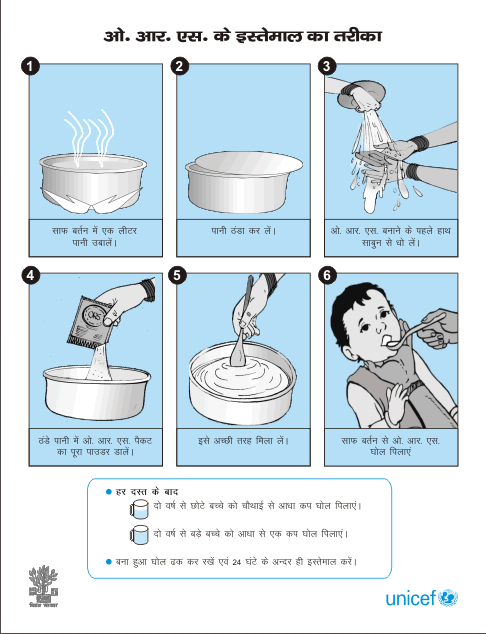
There is no standard definition of diarrhea. Diarrhea may be defined with one or combination of the following criterion: Change in consistency of stool: Increased water-content Increase in freqency of stool: >3 times per day Increase in weight of stool: >200 grams per day or >10 grams/kg/day Among all these,…
Category: PGMEE, MRCS, USMLE, MBBS, MD/MS
Medical knowledge in bullet points with understandable language, simplified images and graspable mnemonics.
PGMEE, MRCS, USMLE, MBBS, MD/MS
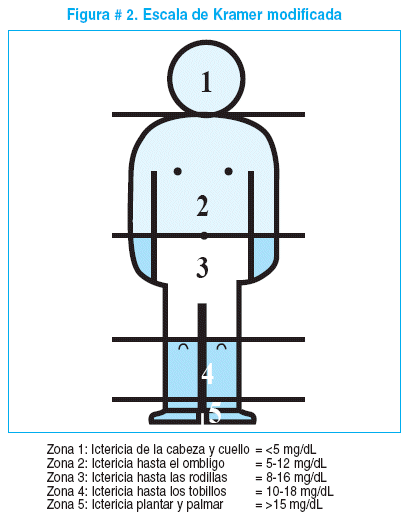
Neonatal Jaundice (NNJ) : Approach
Jaundice refers to accumulation of bilirubin in the epidermal tissues of the body, resulting in a yellowish tinge to the skin, sclera, and mucosa. Atleast 5 mg/dl of bilirubin level is required for clinically recognizing hyperbilirubinemia. A) Physiological Neonatal Jaundice: General consideration:
PGMEE, MRCS, USMLE, MBBS, MD/MS
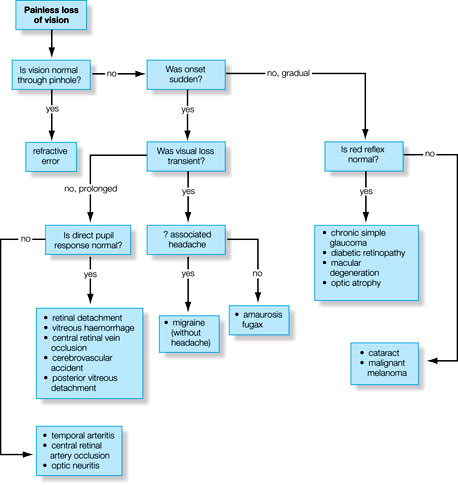
Vision loss – General Appoach
Diagnosis of the etiology of vision loss requires a step-wise systematic approach. The vision loss may be sudden or gradual, painful or painless, unilateral or bilateral, etc. One needs to take a detailed ocular history and examination. Step 1: Sudden or gradual vision loss? a. Sudden: vascular occlusion (e.g., AION, CRAO, CRVO)…
PGMEE, MRCS, USMLE, MBBS, MD/MS
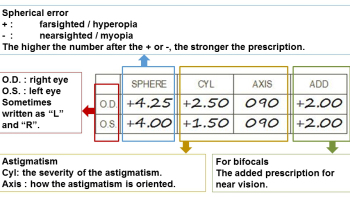
Understanding Eye Glass Prescription Slip
A phoropter/refractor is an instrument commonly used by eye care professionals during an eye examination, containing different lenses used for refraction of the eye during sight testing, to measure an individual’s refractive error and determine his or her eyeglass prescription. Retinoscopy is done instead in children who are unable to…
PGMEE, MRCS, USMLE, MBBS, MD/MS
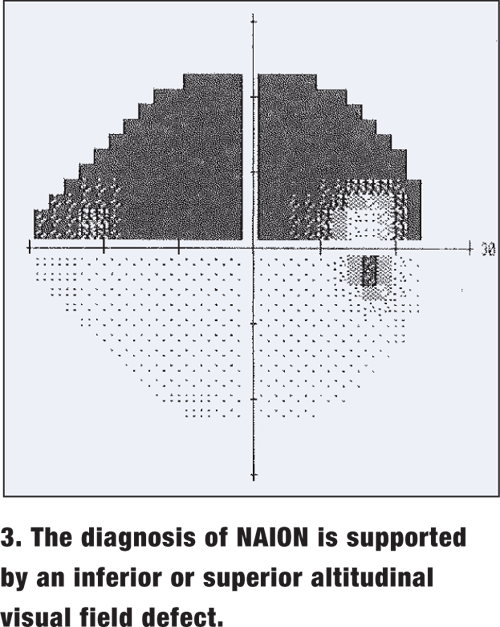
Sudden Vision Loss : Simplified Approach
Acute or sudden vision loss is due to one of the following causes: Opacification of normally transparent structures anterior to retina Retinal abnormalities Abnormalities of optic nerve and visual pathway Systematic history and ocular examination is necessary. Step 1: Unilateral or Bilateral Sudden vision loss ? Monocular loss of vision:…
PGMEE, MRCS, USMLE, MBBS, MD/MS
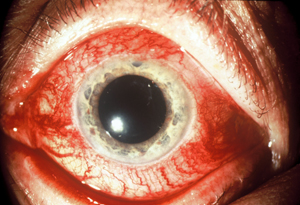
Acute Red Eye : Simplified Approach
Red eye reflects hyperemia or engorgement of superficial visible conjunctival, episcleral or ciliary vessels. A) DIFFERENTIAL DIAGNOSES FOR ACUTE RED EYE 1. Painless red eye: a) Diffuse redness: Lids normal: Conjunctivitis Lids abnormal: Blepharitis Ectropion Trichiasis Eyelid lesion b) Localized redness: Pterygium Corneal foreign body Ocular trauma Subconjunctival hemorrhage Episcleritis
PGMEE, MRCS, USMLE, MBBS, MD/MS
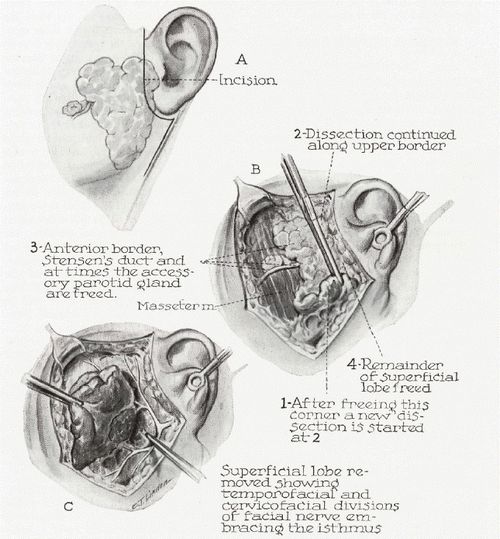
Simplified Approach to Parotid Enlargement
Diagnosis and management of a case of parotid enlargement requires systematic approach. Here, I have tried to present a simplified approach to parotid enlargement. A) DIFFERENTIAL DIAGNOSES OF PAROTID ENLARGEMENT: 1. Infectious: Child: Mumps, Coxsackie Adult: S.aureus 2. Non-infectious benign: Epithelial: Pleomorphic adenoma, Warthin tumor, Oncocytoma, Monomorphic adenoma Non-epithelial: Lymph…
PGMEE, MRCS, USMLE, MBBS, MD/MS
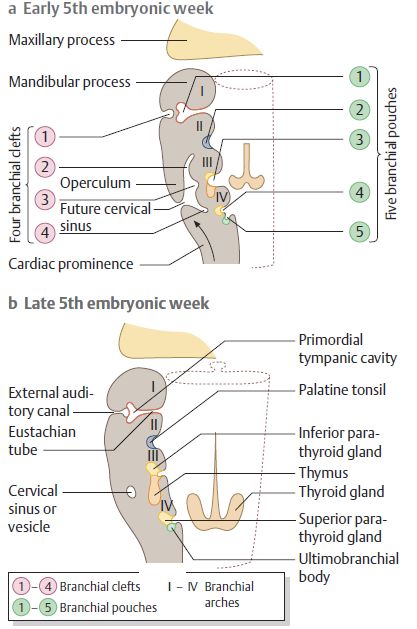
Branchial Apparatus (Pharyngeal arches and pouches) : Mnemonics
Synonym: Pharyngeal apparatus Mnemonic: CAP covers from out to in Pharyngeal arches are equivalent of gill arches in fish that develop in a cranio-caudal sequence. Derivatives of Pharyngeal or Branchial Apparatus Pharyngeal cleft Pharyngeal arch Pharyngeal pouch Ectoderm Mesoderm Neural crest Cranial Nerves Arteries Endoderm 1st External Auditory Meatus…