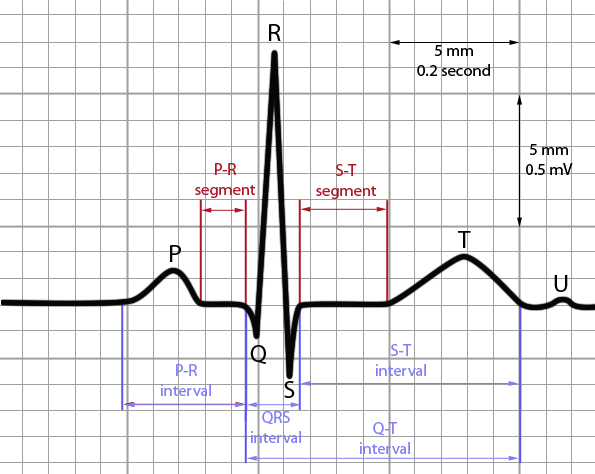
There is an old saying that two surgeons and an ECG form a double-blind-study. Then, there’s a protocol for surgeons intended for humor: All spikes up: Operate All spikes down: Call Medics All spikes missing: Recently: Call Anesthetist A long time ago: Complete death certificate So, let’s think of heart…
Category: PGMEE, MRCS, USMLE, MBBS, MD/MS
Medical knowledge in bullet points with understandable language, simplified images and graspable mnemonics.
PGMEE, MRCS, USMLE, MBBS, MD/MS
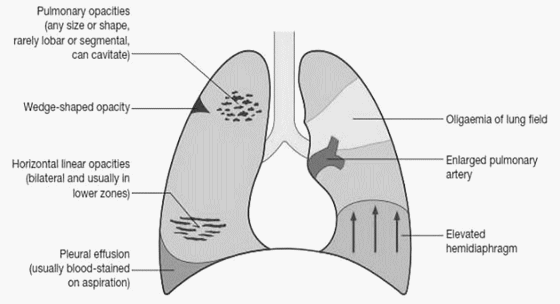
Perioperative Management of Venous thromboembolism (VTE)
Recommended duration of anticoagulant prophylaxis The recommendations are as follows: 1. Provoked DVT (with reversible surgical or nonsurgical provoking factor): 3 months 2. Unprovoked isolated distal DVT (has low risk of recurrence): 3 months 3. Unprovoked proximal DVT or PE: Indefinite therapy if D-dimer positive after 1 month after 3 months of therapy or second VTE…
PGMEE, MRCS, USMLE, MBBS, MD/MS
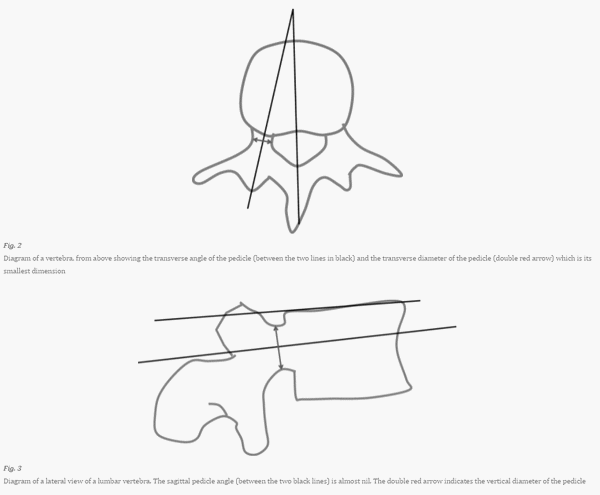
Pedicle Screw Insertion Simplified
Anatomy of Vertebral Pedicle Width (narrowest transverse diameter): Narrowest at T4-T5 (4-5 mm) Above and below this level, the width gradually increases to almost double at T1 and T11 (8 mm) Narrowest for lumbar at L2 (two for tiny; 2 X 3 = 6 mm) Increases gradually to L5 (5…
PGMEE, MRCS, USMLE, MBBS, MD/MS
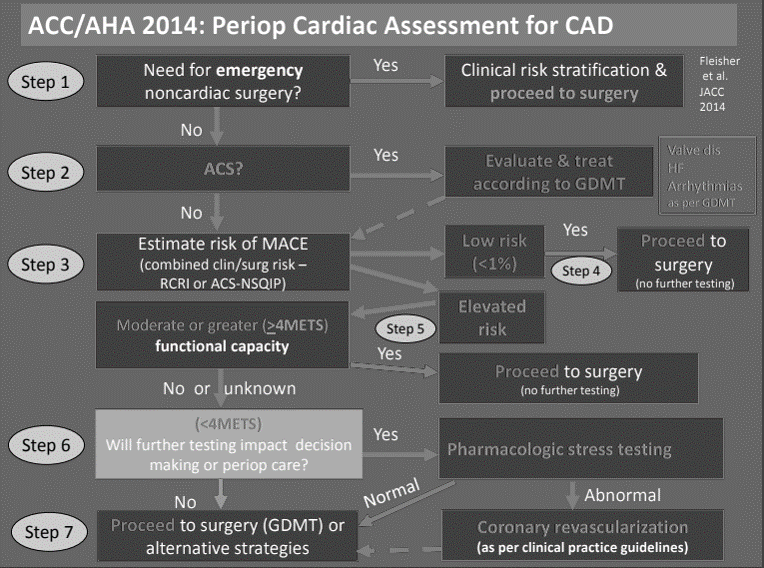
Preoperative Cardiac Evaluation in Non-cardiac Surgery : Mnemonic
Besides, for the emergency/urgent surgeries, one needs to evaluate 4 variables in the preoperative cardiac evaluation of the patient for the non-cardiac surgery. We have elaborated the mnemonics used by CasesBlog. These variables can be remembered by the mnemonic PAST. Patient risk Activity level (METs) Surgical risk Test (Stress test)…
PGMEE, MRCS, USMLE, MBBS, MD/MS
Enzyme Inducers and Inhibitors : Mnemonic
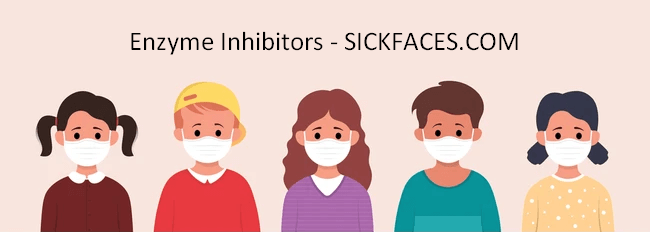
Cytochrome P450 Inducers Mnemonic: SCRAP GP Sulfonylureas, Smoking Carbamazepine, Corticosteroids Rifamycins (Rifampicin, Rifabutin) Alcohol (Chronic) Phenytoin Griseofulvin Phenobarbital Cytochrome P450 Inhibitors Mnemonic 1: VIDEOCASE Valproate Isoniazid Disulfiram Erythromycin, Clarithromycin (not Azithromycin) Omeprazole Cimetidine Allopurinol Sulfonamides Ethanol (Acute) Mnemonic 2: SICKFACES.COM Sodium valproate Isoniazid Cimetidine Ketoconazole Fluconazole Alcohol (Acute) Chloramphenicol Erythromycin…
PGMEE, MRCS, USMLE, MBBS, MD/MS
Valproic acid (Valproate) : Pharmacology
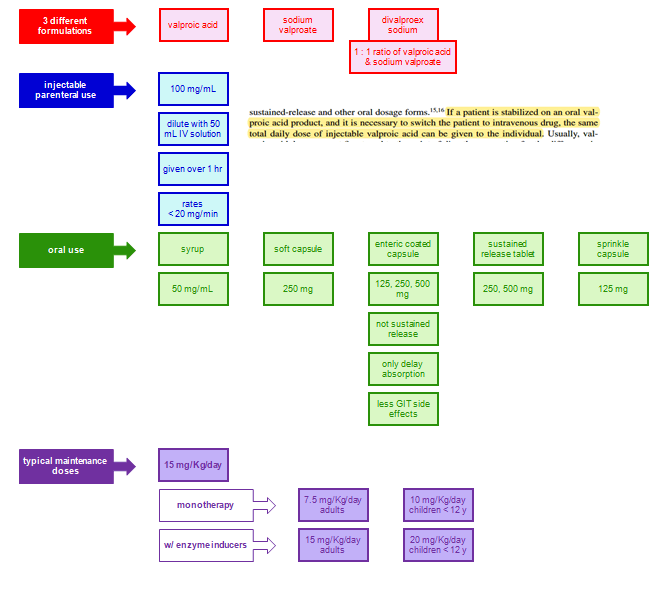
Dosage and Absorption VPA is absorbed through the small intestine, and delayed- and extended-release forms are designed to extend the dosage interval and bypass the stomach to reduce dyspepsia. The liquid and tablet forms have a more than 10-fold higher absorption rate constant than the extended-release forms and peak at…
PGMEE, MRCS, USMLE, MBBS, MD/MS
Dermatomes : Mnemonic
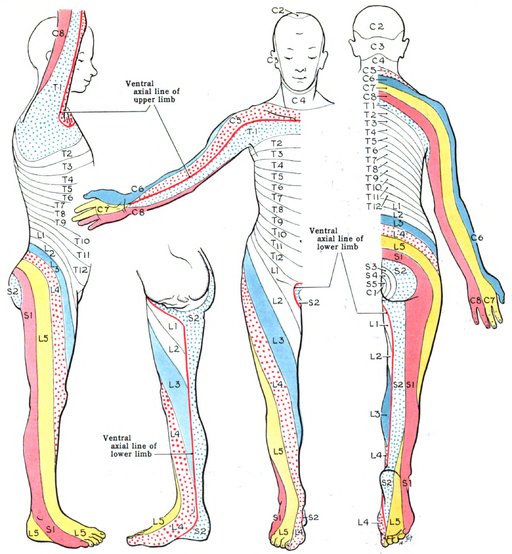
Note: C1 doesn’t have a sensory branch For the purpose of making learning easier, we divide the remaining dermatomal segments into 4 groups which will be accompanied by analogies and mnemonics. C2-C4 These supply the “hooded cape” region. C2: hood region abutting the trigeminal distribution C3: upper neck C4: lower…
PGMEE, MRCS, USMLE, MBBS, MD/MS
Nerve Conduction Study (NCS) and Electromyography (EMG) : Mnemonic Approach
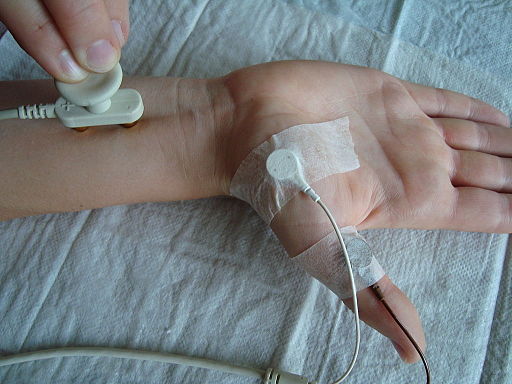
Nerve Conduction Study (NCS) In the Nerve conduction study, assessment must be done for ABCDEFGH. Action potential Amplitude Measures the height of response in millivolts (mV) for motor nerve and microvolts (μV) for sensory nerve Indicates quantity of axons contributing to action potential Block of conduction CMAP on proximal stimulation…