Skip to content
Epomedicine

Mnemonics, Simplified Concepts & Thoughts

Epomedicine

Mnemonics, Simplified Concepts & Thoughts

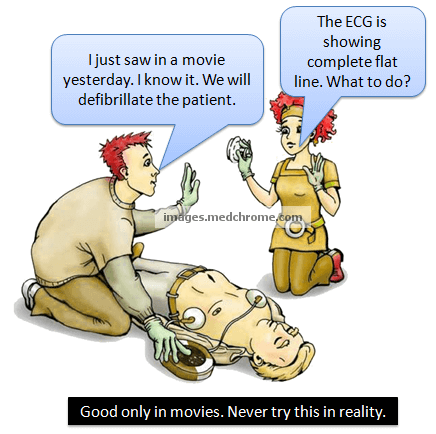
asystole defibrillation

Why to not defibrillate Asystole ?

Dr. Sulabh Kumar Shrestha, MS Orthopedics, Jun 25, 2016Jun 25, 2016
asystole defibrillation
From images.medchrome.com

What is asystole?

Asystole is a state of no cardiac electrical activity.

It is seen as a “flat-line” in ECG monitor. However, other possible causes of flat-line should be ruled out before calling it asystole. They are:

  • Loose or disconnected ECG leads
  • Loss of power to ECG monitor

Once, asystole is confirmed, you must quickly look for possible underlying causes. They can be recalled by the H‘s and T‘s.

  • Hypovolemia, Hypoxia, Hydrogen ion (acidosis), Hyper-/hypokalemia, Hypothermia.
  • Toxins, Tamponade(cardiac), Tension pneumothorax, Thrombosis (coronary and pulmonary).

How does defibrillator work?

Conducting system of heart possess several pacemakers – Sinoatrial (SA) node, Atria, Atrioventricular (AV) node, Ventricles. Under normal conditions, other pacemakers are suppressed by the more rapid impulses from above (i.e. sinus rhythm from SA node). Should the SAN fail to produce impulses the AVN and other pacemakers can take over. Sometimes, an event causes different pace maker cells to start firing out of sequence. As a result, the heart will start to contract in an uncoordinated fashion and will fail to effectively pump blood.

Defibrillator depolarizes a critical mass of the heart muscle (most of the cells to fire at once), synchronize them and allow SA node to takeover the pacemaker function once again when the heart repolarizes.

Why defibrillation of asystole is useless?

Asystole means there is no electrical activity in the myocytes i.e. non-functioning of cardiac pacemakers rather than disorganized functioning of pacemakers. Electrical stimulation of heart activates or deactivates ion pumps. But, if heart has been long deprived of oxygen (hypoxia), necessary electrolytes, etc. – electrical stimulation will not work. So, the primary cause for asystole must be sought and treated to make the heart tissues excitable once again.

There is only one situation in which the monitor shows asystole and the doctor might still decide to defibrillate. That is situation is when the patient is suspected to be having a fine Ventricular Fibrillation.

So how is asystole managed?

Asystole is primarily treated with CPR (Cardiopulmonary Resuscutation) combined with an intravenous vasopressor such as epinephrine (adrenaline).

dr. sulabh kumar shrestha
Dr. Sulabh Kumar Shrestha, MS Orthopedics

He is the section editor of Orthopedics in Epomedicine. He searches for and share simpler ways to make complicated medical topics simple. He also loves writing poetry, listening and playing music. He is currently pursuing Fellowship in Hip, Pelvi-acetabulum and Arthroplasty at B&B Hospital.


20 shares
  • Facebook20
  • Twitter
Blog Cardiovascular systemEmergency medicine

Post navigation

Previous post
Next post

Related Posts

Blog

Unleash the Power of Healthcare Promotional Products in Your Marketing Plan

Aug 31, 2024Aug 31, 2024

Remember a decade ago when every conference and convention you attended, you’d get a goodie bag.  Nine times out of ten, it contained a USB with the company’s name and contact details. You probably have a drawer back home filled with forgotten USBs. The corporate gifts you recall were the…

Read More
Blog

Is Fever a contraindication for Blood transfusion?

Apr 15, 2021Apr 15, 2021

In medical schools, we learn many things without knowing the actual reason behind it. One of them is the pre-transfusion fever in a patient being planned for blood transfusion which is considered as a contraindication for it in many departments and health centers. So, the questions that came into my…

Read More
Blog

4 Medications That Put You at Risk of Cavities

Sep 26, 2024Sep 26, 2024

Countless times, you’ve heard that brushing, flossing, and avoiding sugary food and drinks can help you avoid cavities. You follow these basic practices daily—but guess what? You still have cavities.  It can be frustrating when you’re diligent about oral care yet still face dental issues. But do you know who…

Read More

Leave a Reply Cancel reply

Your email address will not be published. Required fields are marked *

This site uses Akismet to reduce spam. Learn how your comment data is processed.

Shrestha SK. Why to not defibrillate Asystole ? [Internet]. Epomedicine; 2016 Jun 25 [cited 2025 Dec 18]. Available from: https://epomedicine.com/blog/not-defibrillate-asystole/.

Pre-clinical (Basic Sciences)

Anatomy

Biochemistry

Community medicine (PSM)

Embryology

Microbiology

Pathology

Pharmacology

Physiology

Clinical Sciences

Anesthesia

Dermatology

Emergency medicine

Forensic

Internal medicine

Gynecology & Obstetrics

Oncology

Ophthalmology

Orthopedics

Otorhinolaryngology (ENT)

Pediatrics

Psychiatry

Radiology

Surgery

RSS Ask Epomedicine

  • What to study for Clinical examination in Orthopedics?
  • What is the mechanism of AVNRT?

Epomedicine weekly

  • About Epomedicine
  • Contact Us
  • Author Guidelines
  • Submit Article
  • Editorial Board
  • USMLE
  • MRCS
  • Thesis
©2025 Epomedicine . All rights reserved.