Meningitis refers to the inflammation of leptomeninges and underlying subarachnoid cerebrospinal fluid (CSF). Meningism or meningismus is a morbid state characterized by a meningitic syndrome (a triad of headache, photophobia and nuchal rigidity) without intracranial inflammation. Some authors, have also used the term “meningism” or “meningismus” to describe the characteristic signs of meningitis, which may be present in conditions other than meningitis. Apical pneumonia is an important cause of meningismus in children. If the meningeal signs persist for >3 days into antibiotic therapy in meningitis or the initial CSF was not fully compatible with purulent bacterial meningitis, a parameningeal suppurative focus should be considered.
Nuchal rigidity
- Relax the neck muscles by bringing the supine patient to the edge of the bed and allow the head to hang outside the bed for a few seconds.
- Place your hand under the supine patient’s head and gently try to flex the neck and touch the chin to chest.
- Undue resistance implies diffuse irritation of cervical nerve roots from meningeal inflammation.
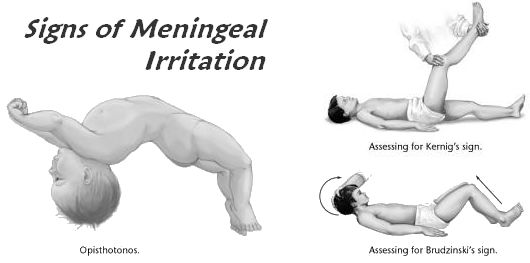
Kernig’s sign
- Flex the hip and knee on one side while the patient is supine.
- Now, extend the knee with the hip still flexed.
- The sign is positive if hamstring spasm results in pain in the posterior thigh and difficulty with knee extension.
- With severe inflammation of meninges, the opposite knee may also flex.
Brudzinski’s neck sign (More sensitive than Kerning’s)
- In a supine patient, place one of your hand behind his/her head and the other on his/her chest.
- Now, flex the patient’s head with the hand behind the head, while your hand on chest restrains the patient and prevents him/her from rising
- The sign is positive if the patient flexes hips and knees.
Brudzinski’s contralateral reflex sign
- This has two components: the identical and reciprocal contralateral reflex.
- Identical contralateral reflex: On passive flexion of patient’s hip and knee on one side, the contralateral leg bends reflexly.
- Reciprocal contralateral reflex: This is positive when the leg contralateral leg that has flexed reflexly begins to extend spontaneously, resembling a “little kick”.
Tripod or Amoss’s or Hoyne’s sign
- The patient is asked to sit up in bed.
- Normally: sits up without supporting himself
- Meningeal irritation: patient tries to sit up by supporting himself with his hands placed far behind him in the bed (like a tripod), in order to take the weight off the spine and prevent its flexion. Severe meningeal irritation may result in the patient assuming the tripod position with the knees and hips flexed, the back arched lordotically, the neck extended, and the arms brought back in a plane posterior to the pelvis to support the thorax.