Skip to content
Epomedicine

Mnemonics, Simplified Concepts & Thoughts

Epomedicine

Mnemonics, Simplified Concepts & Thoughts

Direct Lateral Approach to Radial Shaft

Dr. Sulabh Kumar Shrestha, MS Orthopedics, Jun 22, 2025Jun 22, 2025

Position: Elbow flexed 90 degree and forearm in mid-prone

Landmarks:

  1. Lateral epicondyle of humerus
  2. Tip of radial styloid

Skin incision: Centered over fracture in a straight imaginary line joining lateral epicondyle of humerus and tip of radial styloid

Superficial dissection: Subcutaneous tissue and deep fascia are incised along the line of skin incision

Deep dissection: Interval is developed between Brachioradialis and Extensor carpi radialis longus (ECRL)

  • Superficial radial nerve is not isolated from brachioradialis unless it is crossing the surgical field
  • Pronator teres can be divided partially or completely
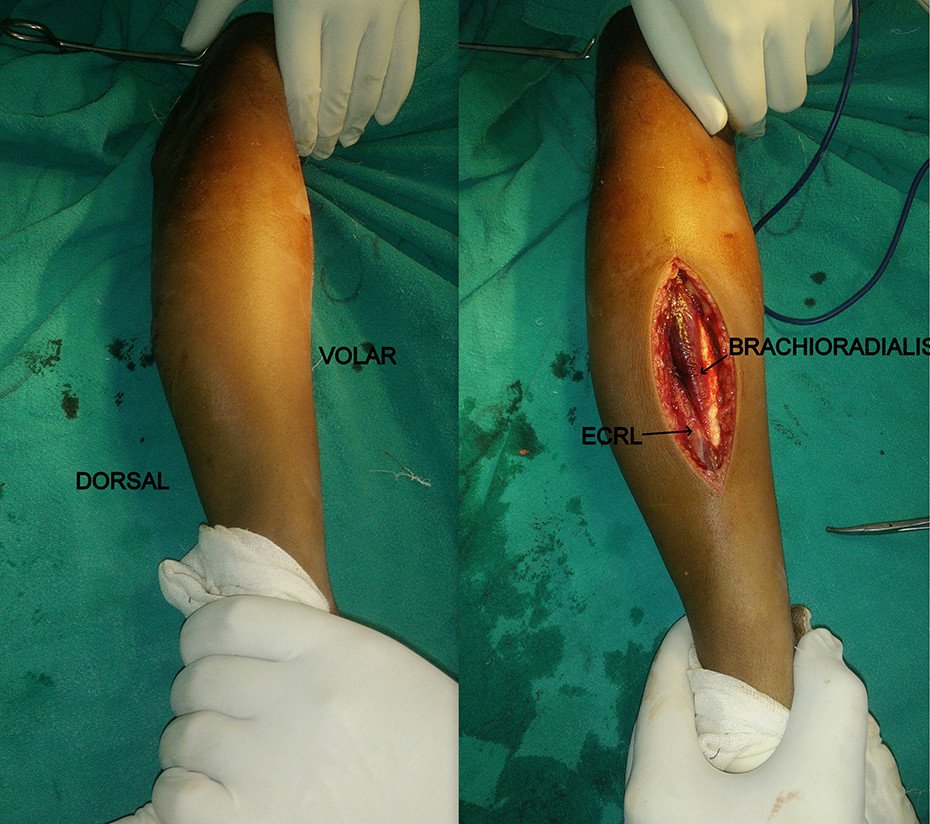
lateral approach to radius
1.
Haseeb M, Muzafar K, Ghani A, Bhat KA, Butt MF. A fresh look at radial shaft fracture fixation: The lateral approach to the radius. Journal of Orthopaedic Surgery. 2018;26(2). doi:10.1177/2309499018780871 [CC BY-NC 4.0]

Fracture fixation:

  • Plate is contoured according to the lateral bow of the radius and plate is applied on the lateral surface of the radius

Further reading:

  1. Haseeb M, Muzafar K, Ghani A, Bhat KA, Butt MF. A fresh look at radial shaft fracture fixation: The lateral approach to the radius. Journal of Orthopaedic Surgery. 2018;26(2). doi:10.1177/2309499018780871
  2. Devaraj B, Navaneethan A, Direct lateral approach to shaft of radius – a cadaver study. Indian J Orthop Surg 2017;3(2):181-183
  3. Muhammad Hanif, Muhammad Saeed Akhtar, Raza Elahi Rana, Shahzad: Direct Lateral Approach to Shaft of Radius. Journal of Pakistan Orthopaedic Association 2014;26 (3):11-14.

    dr. sulabh kumar shrestha
    Dr. Sulabh Kumar Shrestha, MS Orthopedics

    He is the section editor of Orthopedics in Epomedicine. He searches for and share simpler ways to make complicated medical topics simple. He also loves writing poetry, listening and playing music. He is currently pursuing Fellowship in Hip, Pelvi-acetabulum and Arthroplasty at B&B Hospital.
    • Facebook
    • Twitter
    Surgical Skills Orthopedics

    Post navigation

    Previous post
    Next post

    Related Posts

    Surgical Skills

    Allgower Donati Suture Technique

    Jun 5, 2020Aug 26, 2020

    Donati’s suture (commonly called as vertical mattress suture) has a far-far-near-near (F-F-N-N) configuration where the far-through stitches seize the subcutaneous tissue and the near-through stitches seize only the dermis. Allgower Donati Suture or Allgower modification of Donati’s suture is a transition between subcuticular suture and Donati’s or vertical mattress suture…

    Read More
    Surgical Skills

    Percutaneous Achilles Tenotomy for CTEV

    Aug 29, 2022Aug 29, 2022

    Indications Cavus, Adductus and Varus are fully corrected but ankle dorsiflexion remains <10 degrees above neutral Adequate abduction: Best sign: Ability to palpate anterior process of the calcaneus as it abducts out from beneath the talus Abduction of approximately 60 degrees Neutral or slight valgus of os calcis Technique 1….

    Read More
    Surgical Skills DCR

    External Dacryocystorhinostomy (DCR)

    Dec 18, 2013May 31, 2020

    Definition External Dacryocystorhinostomy (DCR) is the surgery to connect the mucosal surface of lacrimal sac to the nasal mucosa by removing the intervening bone. It creates a permanent anastomosis between the lacrimal sac and medial meatus of nose. Prerequisite Common canaliculi must be patent Indications of External Dacryocystorhinostomy Nasolacrimal duct…

    Read More

    Leave a Reply Cancel reply

    Your email address will not be published. Required fields are marked *

    This site uses Akismet to reduce spam. Learn how your comment data is processed.

    Pre-clinical (Basic Sciences)

    Anatomy

    Biochemistry

    Community medicine (PSM)

    Embryology

    Microbiology

    Pathology

    Pharmacology

    Physiology

    Clinical Sciences

    Anesthesia

    Dermatology

    Emergency medicine

    Forensic

    Internal medicine

    Gynecology & Obstetrics

    Oncology

    Ophthalmology

    Orthopedics

    Otorhinolaryngology (ENT)

    Pediatrics

    Psychiatry

    Radiology

    Surgery

    RSS Ask Epomedicine

    • What to study for Clinical examination in Orthopedics?
    • What is the mechanism of AVNRT?

    Epomedicine weekly

    • About Epomedicine
    • Contact Us
    • Author Guidelines
    • Submit Article
    • Editorial Board
    • USMLE
    • MRCS
    • Thesis
    ©2026 Epomedicine | WordPress Theme by SuperbThemes