Skip to content
Epomedicine

Mnemonics, Simplified Concepts & Thoughts

Epomedicine

Mnemonics, Simplified Concepts & Thoughts

Boyd (Posterolateral) Approach to Elbow

Epomedicine, Jul 22, 2025Jul 22, 2025

Indications:

  1. Monteggia fractures
  2. Mayo type II olecranon fractures

Skin incision: Begin the incision just posterior to the lateral epicondyle and lateral to the triceps tendon, and continue the incision distally to the lateral tip of the olecranon and then down the subcutaneous border of the ulna to the junction of its proximal and middle thirds or as necessary

Superficial dissection: Incise the deep fascia in line with the incision to approach the lateral margin of the ulna between the anconeus insertion and the flexor carpi ulnaris.
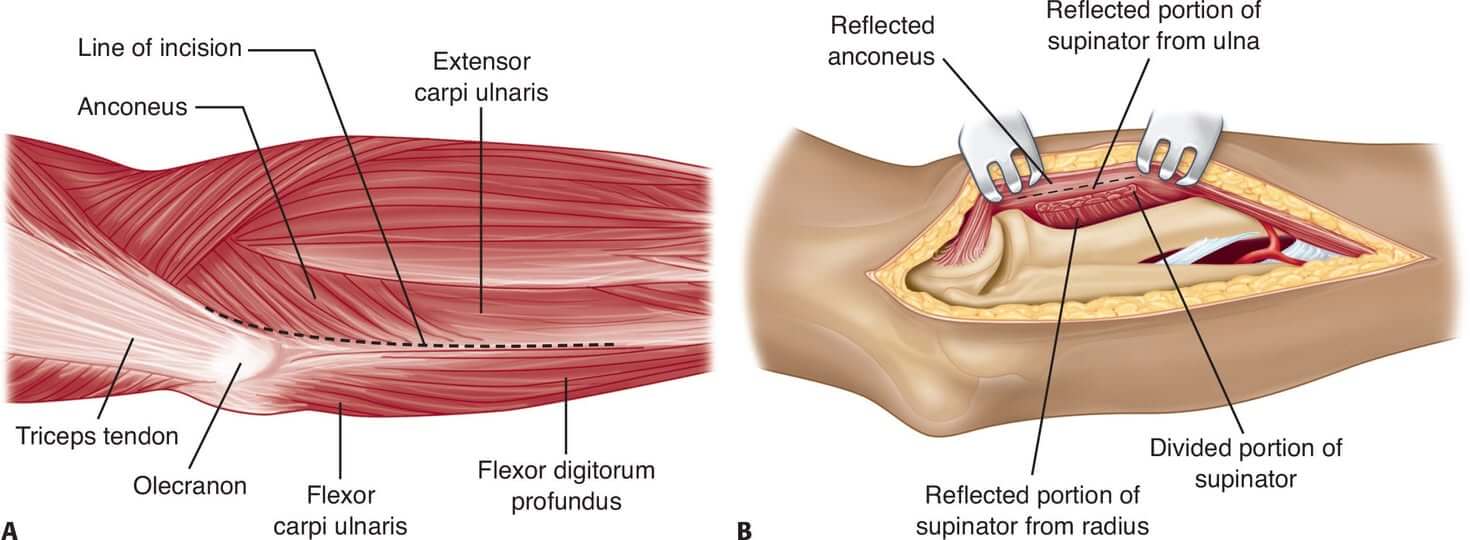
boyd approach

Deep dissection: The anconeus and extensor carpi ulnaris are stripped subperiosteally from the ulna, beginning on the lateral subcutaneous crest of the bone and reflecting the muscles volar-ward. The supinator is released subperiosteally from its ulnar insertion, and the entire muscle mass is reflected anteriorly.

Deep to this layer, the annular ligament, the lateral ulnar collateral ligament (LUCL), and the joint capsule complex are identified. The radial head can be palpated deep to these. Attention should be paid to the insertion sites of these structures for later reference when performing an anatomic repair. The ligaments and capsule are released directly off the ulna at the supinator crest using sharp dissection.

Further reading:

  1. Speed and Boyd’s approach to the forearm shaft
  2. Posterolateral (Boyd) approach to the pediatric proximal radius and ulna
  3. Versatility Through the Boyd Approach – Eric G. Huish, Jr, DO and Marc A. Trzeciak, DO
  • Facebook
  • Twitter
Surgical Skills OrthopedicsSurgical skills

Post navigation

Previous post
Next post

Related Posts

Surgical Skills

Aberdeen Knot

Feb 10, 2023Feb 10, 2023

To end continuous suture, either a square knot, surgeon’s knot or an Aberdeen knot is required. The Aberdeen knot has been shown to be superior to a surgeon’s knot. Recommendations on number of throws: Technique/Steps:

Read More
Surgical Skills

Running subcuticular suturing

Feb 9, 2023Feb 10, 2023

1. Start with a buried knot at distal apex of the wound. 2. Take a bite deep to the epidermis that should curve parallel to the skin surface and exit in the same plane approximately 5-10mm along the wound, taking care to stay at the same level. 3. Continue step…

Read More
Surgical Skills

Surgical Blades

Jul 23, 2020Jul 25, 2020

One of the oldest surgical instruments used even today is a Scalpel (Surgical Blade with a Bard Parker Handle). Long before using metals in manufacturing, parts from various flora and fauna were used in making incisions during surgeries. Few examples are listed below. Table 1. Various objects used to make incisions. The…

Read More

Leave a Reply Cancel reply

Your email address will not be published. Required fields are marked *

This site uses Akismet to reduce spam. Learn how your comment data is processed.

Pre-clinical (Basic Sciences)

Anatomy

Biochemistry

Community medicine (PSM)

Embryology

Microbiology

Pathology

Pharmacology

Physiology

Clinical Sciences

Anesthesia

Dermatology

Emergency medicine

Forensic

Internal medicine

Gynecology & Obstetrics

Oncology

Ophthalmology

Orthopedics

Otorhinolaryngology (ENT)

Pediatrics

Psychiatry

Radiology

Surgery

RSS Ask Epomedicine

  • What to study for Clinical examination in Orthopedics?
  • What is the mechanism of AVNRT?

Epomedicine weekly

  • About Epomedicine
  • Contact Us
  • Author Guidelines
  • Submit Article
  • Editorial Board
  • USMLE
  • MRCS
  • Thesis
©2026 Epomedicine | WordPress Theme by SuperbThemes