Skip to content
Epomedicine

Mnemonics, Simplified Concepts & Thoughts

Epomedicine

Mnemonics, Simplified Concepts & Thoughts

PQLI vs HDI : Mnemonic

Epomedicine, Aug 24, 2024Aug 24, 2024

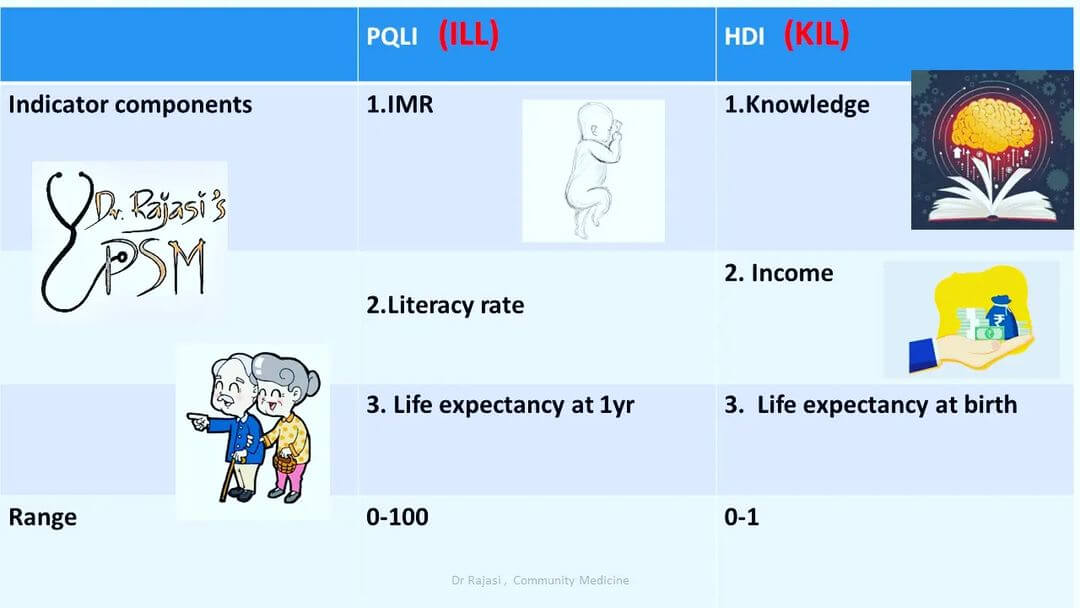
PQLI and HDI are similar, the main difference between the two being the inclusion of income in HDI & exclusion of same from PQLI. HDI represents both physical and financial attributes of development and PQLI has only physical aspects of life.
pqli vs hdi
PQLIHDI
Full formPhysical Quality of Life IndexHuman Development Index
ComponentsMnemonic: ILLMnemonic: KIL
1. Infant mortality rate1. Knowledge
2. Life expectancy at 1 year age2. Income
3. Literacy3. Longevity (life expectancy at birth)
Range0 to 1000 to +1
Value of Nepal57.5 (as of 2023)0.602 (as of 2021)
View this post on Instagram

A post shared by Dr Rajasi PSM (@drrajasi22)

  • Facebook
  • Twitter
PGMEE, MRCS, USMLE, MBBS, MD/MS Community medicine

Post navigation

Previous post
Next post

Related Posts

PGMEE, MRCS, USMLE, MBBS, MD/MS gastric glands

Gastric glands and cells

Jul 15, 2018Jun 16, 2023

Anatomically, stomach can be divided into 3 parts from above to below: Gastric pits deepen as we move below from cardiac to pyloric glands. Mucus secreting cells: Present in all 3 glands – cardiac, fundic and pyloric but predominate in cardiac and pyloric glands. Pyloric glands have 1 more cell…

Read More
PGMEE, MRCS, USMLE, MBBS, MD/MS tnm staging system

TNM Classification and Cancer Staging Simplified

Aug 14, 2016Aug 14, 2016

You must be asking yourself – “how to remember the TNM staging system?” and looking here and there for mnemonics only to find nowhere. Understanding the oncoanatomy helps to understand the staging system of the cancers. Tumor Status (T) T1 T2 T3 T4 Depth of invasion Solid organs Confined Capsule,…

Read More
PGMEE, MRCS, USMLE, MBBS, MD/MS

Osteopetrosis : Mnemonic

Jul 20, 2022Jul 20, 2022

Synonyms: Marble bone disease Albers-Schonberg disease (Autosomal dominant form) Mnemonic: OSTEOPETROSIS Osteoclast dysfunction (Carbonic anhydrase II gene mutation or chloride channel dysfunction) Symmetric skeletal sclerosis Thickened cortex with loss of medullary canal diameter (bone in bone appearance) Extramedullary hematopoiesis (aplastic anemia and hepatosplenomegaly) Overgrowth of skull foramina (cranial nerve palsies)…

Read More

Leave a Reply Cancel reply

Your email address will not be published. Required fields are marked *

This site uses Akismet to reduce spam. Learn how your comment data is processed.

Pre-clinical (Basic Sciences)

Anatomy

Biochemistry

Community medicine (PSM)

Embryology

Microbiology

Pathology

Pharmacology

Physiology

Clinical Sciences

Anesthesia

Dermatology

Emergency medicine

Forensic

Internal medicine

Gynecology & Obstetrics

Oncology

Ophthalmology

Orthopedics

Otorhinolaryngology (ENT)

Pediatrics

Psychiatry

Radiology

Surgery

RSS Ask Epomedicine

  • What to study for Clinical examination in Orthopedics?
  • What is the mechanism of AVNRT?

Epomedicine weekly

  • About Epomedicine
  • Contact Us
  • Author Guidelines
  • Submit Article
  • Editorial Board
  • USMLE
  • MRCS
  • Thesis
©2026 Epomedicine | WordPress Theme by SuperbThemes