Skip to content
Epomedicine

Mnemonics, Simplified Concepts & Thoughts

Epomedicine

Mnemonics, Simplified Concepts & Thoughts

Mirel’s Criteria or Score – Mnemonic

Epomedicine, Apr 10, 2020Apr 10, 2020

Mirel’s scoring system rates 4 criteria from 1 to 3 with maximum possible score of 12 to assess the risk of pathological fracture due to metastases and also serves as a guide for considering prophylactic fixation. The parameters of the criteria can be remembered using the mnemonic MIREL’S.
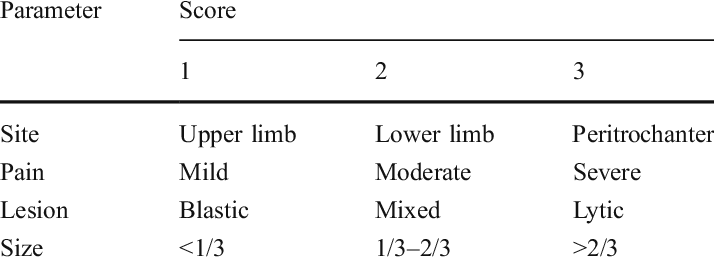
mirel's criteria
  1. M – Morphology of metastases
  2. I – Intensity of pain
  3. R – Ratio of lesion size to bone diameter (as seen on plain radiograph)
  4. E – Eight (cut-off value)
  5. L – Location of metastases
  6. ‘S – Looks like 15 (score 8 = 15% risk of pathological fracture)
ScoreSite of lesionSize of lesionNature of lesionPain
1Upper limb< 1/3 of cortexBlasticMild
2Lower limb1/3–2/3 of cortexMixedModerate
3Trochanteric region> 2/3 of cortexLyticFunctional

He recommended prophylactic fixation with a patient scoring more than 8 or more. With this scoring system, patient with functional pain (severe pain at rest or pain with use of limb) and lytic lesion automatically scores 8 or more. However, it was created before the bisphosphonates were used. With a score of 8, clinical judgement is necessary for decision making.

Mirels’ scoreClinical recommendation
≤ 7Radiotherapy and observation
8Use clinical judgment
≥ 9Prophylactic fixation

Risk of pathological fracture according to Mirel’s score:

  1. <6: 0%
  2. 8: 15%
  3. 12: 100%

Harrington (preceded Mirel’s criteria and is not validated) defined an impending fracture as:

  1. ‘Lytic’ bony lesion
  2. Involving > ½ the diameter of the bone (>2.5 cm in greatest diameter)
  3. Associated with persistent pain
  4. Radiographic progression after radiation.

Example: A lytic metastasis in the proximal diaphysis of right femur which encompasses half of the diameter of bone producing severe limb pain at rest would score: 3 (lytic) + 2 (lower limb) + 2 (1/2 diameter) + 3 (functional pain) = 10. This is an impending fracture according to Harrington’s criteria as well. Fracture is likely to occur without operative intervention and hence, prophylactic fixation with intramedullary nail should be considered in this case.
  • Facebook
  • Twitter
PGMEE, MRCS, USMLE, MBBS, MD/MS Musculoskeletal systemOrthopedicsRadiology

Post navigation

Previous post
Next post

Related Posts

PGMEE, MRCS, USMLE, MBBS, MD/MS lactational amenorrhea mechanism

Management of Puerperium

Apr 3, 2016

Normal puerperium has been already discussed earlier here. A) Immediately after labor within 1 hour Blood pressure and heart rate atleast every 15 minutes Monitor amount of vaginal bleeding Palpate fundus to ensure amount adequate contractions (if relaxed – massage uterus to enhance oxytocin release) B) 1st several hours 1….

Read More
PGMEE, MRCS, USMLE, MBBS, MD/MS

Interpretation of NCCT head: Normal findings

Apr 17, 2024Apr 17, 2024

History: In 1972, Sir Godfrey Hounsfield developed CT scan for which he was awarded Nobel prize in 1979. Through these years CT has come from one rotation in 6 minutes to one in 0.33 seconds. Principle: X rays are produced by CT machine, which are absorbed by different tissues in…

Read More
PGMEE, MRCS, USMLE, MBBS, MD/MS

Internal Iliac Artery Anatomy : Simplified

Oct 5, 2020Oct 5, 2020

Origin L5-S1 (common iliac artery bifurcation; anterior to SI joint) Course Extends down and posteriorly ~4 cm until superior margin of greater sciatic foramen and bifurcates into 2 trunks (in 60% cases) – Anterior trunk: continuation of the main artery towards ischial spine Posterior trunk: passes towards greater sciatic foramen…

Read More

Leave a Reply Cancel reply

Your email address will not be published. Required fields are marked *

This site uses Akismet to reduce spam. Learn how your comment data is processed.

Pre-clinical (Basic Sciences)

Anatomy

Biochemistry

Community medicine (PSM)

Embryology

Microbiology

Pathology

Pharmacology

Physiology

Clinical Sciences

Anesthesia

Dermatology

Emergency medicine

Forensic

Internal medicine

Gynecology & Obstetrics

Oncology

Ophthalmology

Orthopedics

Otorhinolaryngology (ENT)

Pediatrics

Psychiatry

Radiology

Surgery

RSS Ask Epomedicine

  • What to study for Clinical examination in Orthopedics?
  • What is the mechanism of AVNRT?

Epomedicine weekly

  • About Epomedicine
  • Contact Us
  • Author Guidelines
  • Submit Article
  • Editorial Board
  • USMLE
  • MRCS
  • Thesis
©2026 Epomedicine | WordPress Theme by SuperbThemes