Skip to content
Epomedicine

Mnemonics, Simplified Concepts & Thoughts

Epomedicine

Mnemonics, Simplified Concepts & Thoughts

Kocher Criteria for Septic Arthritis : Mnemonic

Epomedicine, Apr 25, 2020Apr 25, 2020

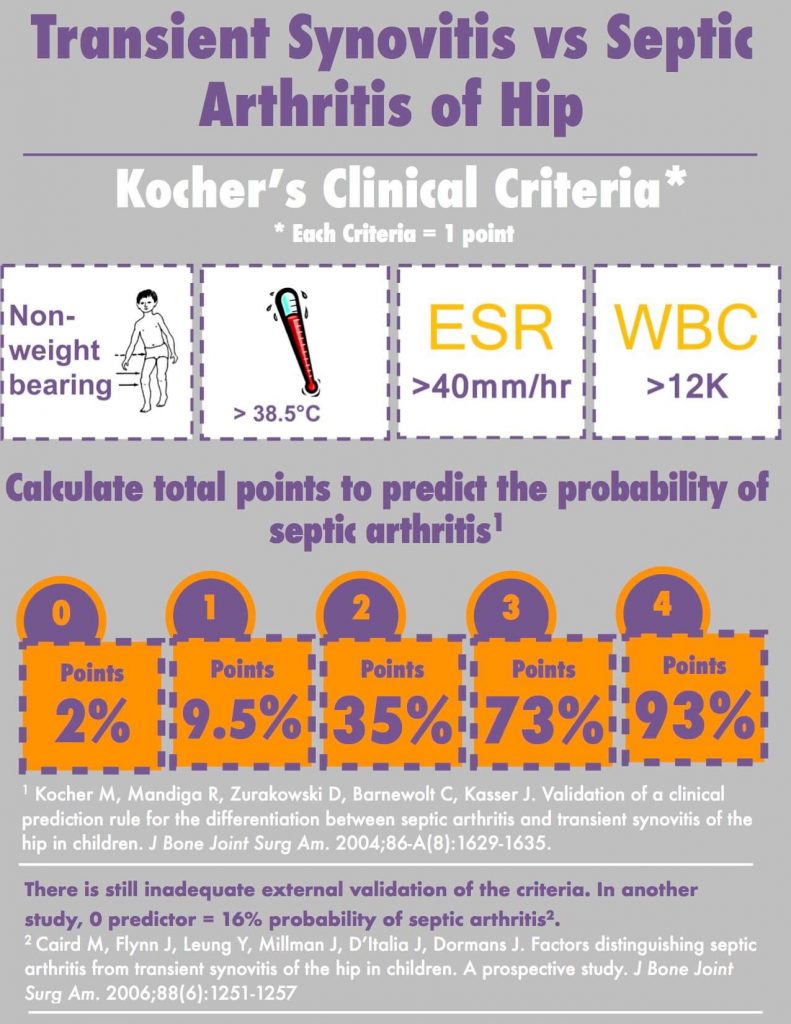
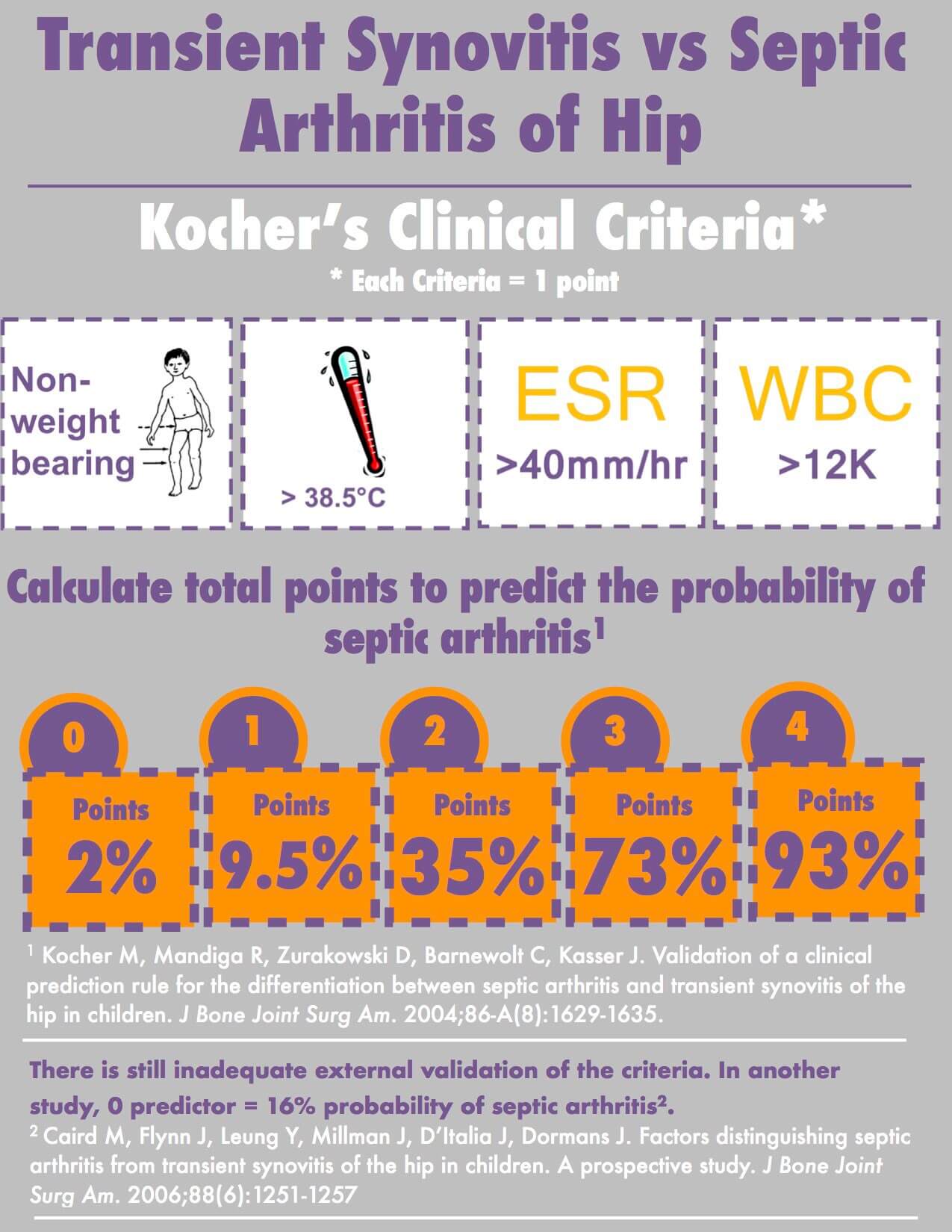
Kocher criteria can help to differentiate between spetic arthritis and transient synovitis in a case of non-traumatic painful hip in a child.

A restrospective study in 104 pediatric patients has depicted that meeting 3 out of 4 crtieria would miss 52% cases and is of limited usefulness in detecting septic arthritis of knee in pediatric population. 1Obey MR, Minaie A, Schipper JA, Hosseinzadeh P. Pediatric Septic Arthritis of the Knee: Predictors of Septic Hip Do Not Apply. J Pediatr Orthop. 2019 Nov/Dec;39(10):e769-e772. doi: 10.1097/BPO.0000000000001377. PubMed PMID: 30950940.

Another study has demonstrated the limited utility of Kocher criteria in the adult population. 2Borzio R, Mulchandani N, Pivec R, Kapadia BH, Leven D, Harwin SF, Urban WP. Predictors of Septic Arthritis in the Adult Population. Orthopedics. 2016 Jul 1;39(4):e657-63. doi: 10.3928/01477447-20160606-05. Epub 2016 Jun 13. PubMed PMID: 27286047.

kocher criteria

Mnemonic for Kocher Criteria: Walk FEW

1. Walking or weight bearing inability
2. Fever > 101.3°F or > 38.5°c
3. ESR >40 mm/hr
4. WBC >12,000/cu.mm

Probability of septic arthritis with number of criterion met:

  1. 4 out of 4: 99%
  2. 3 out of 4: 93 %
  3. 2 out of 4: 40%
  4. 1 out of 4: 3%
  5. 0 out of 4: 0.2%

Caird et.al. (2006) added CRP to the Kocher criteria. CRP ≥ 20 mg/L is another predictor of septic arthritis. The best predictor of septic arthritis is fever followed closely by raised CRP. A study by Walker et.al. revealed that an elevated CRP (2.0mg/dL) and inability to bear weight together resulted in a PPV of 78%. With a CRP threshold of 3.0mg/dL and inability to bear weight, the PPV was 81%. 3Septic arthritis of the pediatric hip: Re-evaluating a predictive algorithm – Justin W. Walker and William HennrikusPediatrics May 2018, 142 (1 MeetingAbstract) 284; DOI: https://doi.org/10.1542/peds.142.1_MeetingAbstract.284

The modified Kocher criteria can be easily remembered using the mnemonic: WAIT
1. WBC
2. Acute phase reactants: ESR and CRP
3. Inability to walk
4. Temperature
50 shares
  • Facebook43
  • Twitter
PGMEE, MRCS, USMLE, MBBS, MD/MS Musculoskeletal systemOrthopedicsPediatrics

Post navigation

Previous post
Next post

Related Posts

PGMEE, MRCS, USMLE, MBBS, MD/MS

Trichomycosis Axillaris : Malodorous yellowish armpit hair

Apr 24, 2021Apr 24, 2021

Synonym: Trichobateriosis axillaris, Bacterial trichonodosis, Trychomycosis palmellina Definition: Asymptomatic superficial bacterial infection (mycosis is a misnomer because it is not a fungal infection) primarily of the axillary hairs (can also occur in pubic, perianal and scalp hair) caused by Corynebacterium sp. Causative organism: Corynebacterium species particularly Corynebacterium flavescens Mode of infection: Bacteria…

Read More
PGMEE, MRCS, USMLE, MBBS, MD/MS

How to crack Postgraduate MD/MS Entrance Examination?

May 24, 2024May 26, 2024

(Article for Nepalese/ Indian and South Asian students) Postgraduate entrance exam for MD/MS is one of the toughest examinations in Nepal. The cut throat competition, the dilemma between studying or earning, and the pressure to perform against the toppers and best minds in the country make it one of the…

Read More
PGMEE, MRCS, USMLE, MBBS, MD/MS

Periprosthetic Joint Infection (PJI) Criteria and Management

Aug 23, 2020Sep 10, 2022

The 2013 ICM criteria for defining Periprosthetic joint infection (PJI) can be remembered using the mnemonic below: Mnemonic: 1 tract or 2 bact. and 3 of ABCDEF 1 sinus tract communication with the joint OR 2 positive periprosthetic cultures with phenotypically identical bacteria AND 3 of the following six minor…

Read More

Leave a Reply Cancel reply

Your email address will not be published. Required fields are marked *

This site uses Akismet to reduce spam. Learn how your comment data is processed.

Pre-clinical (Basic Sciences)

Anatomy

Biochemistry

Community medicine (PSM)

Embryology

Microbiology

Pathology

Pharmacology

Physiology

Clinical Sciences

Anesthesia

Dermatology

Emergency medicine

Forensic

Internal medicine

Gynecology & Obstetrics

Oncology

Ophthalmology

Orthopedics

Otorhinolaryngology (ENT)

Pediatrics

Psychiatry

Radiology

Surgery

RSS Ask Epomedicine

  • What to study for Clinical examination in Orthopedics?
  • What is the mechanism of AVNRT?

Epomedicine weekly

  • About Epomedicine
  • Contact Us
  • Author Guidelines
  • Submit Article
  • Editorial Board
  • USMLE
  • MRCS
  • Thesis
©2026 Epomedicine | WordPress Theme by SuperbThemes