Infiltration anaesthesia is one of the simplest and most useful techniques of local anaesthesia, particularly when resources are limited or when general anaesthesia is undesirable. It can be used alone for minor procedures or combined with regional nerve blocks for larger operations. Common applications include wound suturing, circumcision, excision of small cysts and lipomas, and infiltration of tissue planes during procedures such as hernia repair.
Advantages of Infiltration Anaesthesia
The major advantages include:
- Simple technique requiring minimal equipment.
- Useful for minor procedures and selected larger operations.
- Can be performed without general anaesthesia.
- May be suitable for high-risk or critically ill patients when carefully administered.
- Can provide excellent analgesia when the anaesthetic is deposited accurately around the operative field.
Limitations and Contraindications
Despite its usefulness, infiltration anaesthesia has several limitations:
- It can be time-consuming, particularly for extensive operative fields.
- It does not provide abdominal muscle relaxation, which may limit its usefulness for some abdominal procedures.
- Avoid infiltration through areas of cellulitis or active infection, as needle penetration may contribute to the spread of infection.
- Inadequate infiltration may result in pain during surgery, so the anaesthetic should always be administered ahead of the planned incision.
Patients should also be appropriately prepared and kept Nil per oral (NPO) because a local anaesthetic technique may occasionally fail or prove inadequate, making conversion to another anaesthetic technique necessary.
Local Anaesthetic Preparation
The concentration and total dose of local anaesthetic should be calculated before starting the procedure.
A commonly described dilute solution is 0.4% lignocaine. For example, 20 mL of 2% lignocaine diluted with 80 mL of sterile saline produces 100 mL of 0.4% lignocaine.
When adrenaline is appropriate, it may be added to reduce systemic absorption and prolong the duration of local anaesthesia. The exact dose and concentration should be calculated carefully, and the maximum recommended dose should always be considered according to the patient’s weight, clinical condition, drug concentration, and whether adrenaline is used.
Important: Maximum-dose recommendations vary according to the local anaesthetic, formulation, patient factors, and current guidelines. Do not rely on historical dosing instructions without checking current prescribing information or institutional protocols.
Equipment: Syringes and Needles
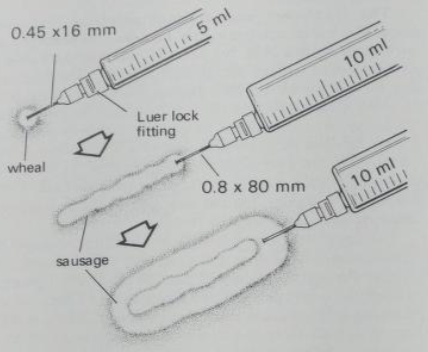
Secure connections between the syringe and needle are important. Luer-lock syringes are preferred because they reduce the risk of accidental disconnection during injection.
Different needle sizes can be selected according to the procedure:
- A fine needle may be used for the initial skin wheal.
- A larger needle may be used for deeper infiltration.
- Needle length should correspond to the depth and anatomical area being infiltrated.
Sharp needles reduce tissue trauma and pain. A blunt needle should be replaced rather than repeatedly forced through tissue.
A useful modification is connecting the needle to the syringe with a short length of sterile extension tubing. This allows the operator to manipulate the syringe without unnecessarily moving the needle tip within the tissues.
Needle Depth Markers
During deep infiltration, it can sometimes be difficult to judge how far the needle has entered the tissues. A sterile marker placed at a predetermined distance from the needle tip can help the operator recognize the approximate depth of insertion.
Never insert a needle completely to the hub. Leaving an appropriate length of needle outside the skin is important because a needle that breaks at the hub can be difficult to retrieve.
Technique for Small Procedures
Good communication with the patient is an important part of local anaesthesia. Explain the procedure and warn the patient that they may feel pressure or a brief initial prick.
Step 1: Prepare the operative field
Clean the skin using an appropriate antiseptic solution and maintain an aseptic technique.
Step 2: Create an initial skin wheal
Using a fine needle, inject a small amount of local anaesthetic intradermally at the planned entry point. This produces a small raised wheal.
Allow sufficient time for the superficial anaesthesia to develop before introducing the larger infiltration needle.
Step 3: Infiltrate along the incision
Introduce the larger needle through the anaesthetized wheal and advance it along the intended line of incision.
Inject slowly into the superficial tissues while keeping the needle close to the skin surface. An orange-peel or peau d’orange appearance of the skin indicates superficial infiltration.
Step 4: Infiltrate deeper tissues
Continue infiltration into the subcutaneous tissues until an adequate field of anaesthesia has been created.
The needle should be advanced and withdrawn gradually while injecting rather than depositing a large volume at a single point. This distributes the anaesthetic more evenly and may reduce the likelihood of intravascular injection.
Step 5: Extend the anaesthetic field
If multiple needle insertions are required, introduce the needle through areas that are already anaesthetized whenever possible. This minimizes discomfort and helps achieve the goal of limiting the patient to a single significant needle prick.
Be generous enough with infiltration to ensure adequate anaesthesia, and always inject ahead of the knife. Never incise into an area simply to test whether it has become numb.
Field Block for Small Lesions
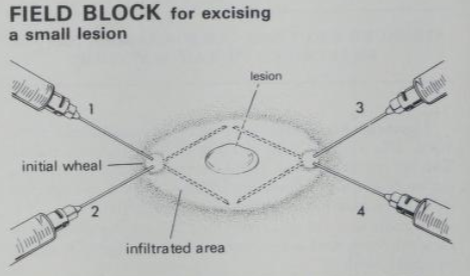
When excising a small cyst, lipoma, or other superficial lesion, the anaesthetic can be deposited around the lesion rather than directly into it.
A practical approach is to create initial wheals at suitable points around the lesion and then infiltrate through these sites to create a continuous field of anaesthesia. A diamond-shaped or circumferential anaesthetic field can then be created around the lesion before incision.
This approach can provide effective anaesthesia while minimizing distortion of the lesion itself.
Practical Points
Several principles make infiltration anaesthesia more comfortable and effective:
Anaesthetize before cutting. The patient should not be used to determine whether an area has been adequately infiltrated.
Use previously anaesthetized skin for subsequent needle entry. This minimizes the number of painful needle pricks.
Keep the needle moving during infiltration. This helps distribute the solution through the tissues rather than depositing a large volume at one point.
Use appropriate needle length. The needle should be long enough to reach the intended tissue plane but should never be inserted completely to the hub.
Calculate total drug dose. Large volumes of dilute local anaesthetic can still produce toxic systemic concentrations.
Reference: Primary Anaesthesia – Edited by Maurice King

Anesthesiology Resident (PGY-1) at Tribhuvan University Teaching Hospital, Institute of Medicine (TUTH, IOM). Her academic interests include perioperative medicine, regional anesthesia, and evidence-based practices in anesthesiology. She contributes scholarly articles on anesthesia to Epomedicine.