Skip to content
Epomedicine

Mnemonics, Simplified Concepts & Thoughts

Epomedicine

Mnemonics, Simplified Concepts & Thoughts

hypertensive retinopathy

Hypertensive Retinopathy Grading – Simplified

Epomedicine, Jun 1, 2019Jun 1, 2019

Hypertensive retinopathy has been classified by Keith, Wagener & Barker and Scheie (hypertensive and arteriosclerotic features). With this mnemonic, we will have a grading with combination of all these classifications.
hypertensive retinopathy
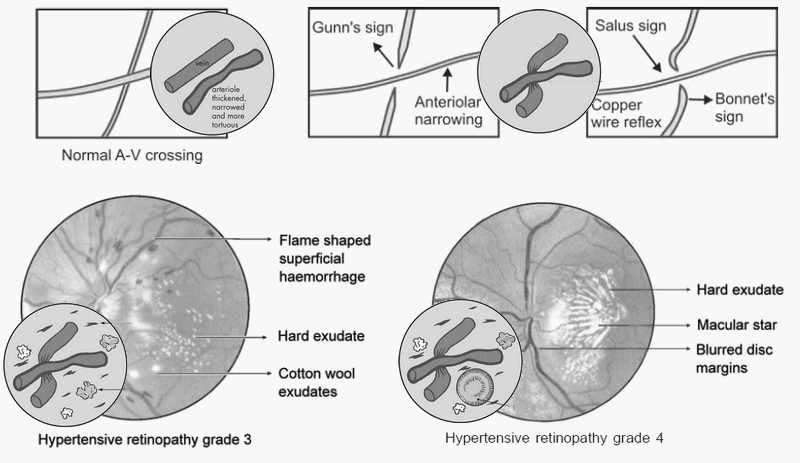
Hypertensive retinopathy changes – schematic

Mnemonic: SAFEs

I – Slight Systemic (generalized) narrowing of arterioles

II – AV deflection (at Angle) and focal narrowing of arteriorles

  • Angled deflection of vein at AV crossing: Salu’s sign

III – Flame hemorrhages, Flame color arterioles and Frank AV crossing changes

  • Frank AV crossing changes:
    • Bonnet sign: Banking of veins at AV crossing
    • Marcus-gunn sign: Tapering of veins at AV crossing
  • Flame color arterioles: Copper wiring
  • Flame shaped hemorrhages, Cotton wool exudates and hard exudates

Mnemonic for Eponymous AV crossing changes:

Salu’s sign: “S” like venous deflection at AV crossing
Bonnet sign: “B” for Banking of vein distal to AV crossing
Gunn sign:

IV – Edema and Exudates surrounding macula + silver wiring

  • Edema: Papilledema
  • Exudates surrounding macula: Macular star
20 shares
  • Facebook20
  • Twitter
PGMEE, MRCS, USMLE, MBBS, MD/MS Emergency medicineInternal medicineOphthalmology

Post navigation

Previous post
Next post

Related Posts

PGMEE, MRCS, USMLE, MBBS, MD/MS

Pheochromocytoma : Mnemonics

Jun 25, 2023Jun 25, 2023

Pheochromocytoma is a catecholamine-producing tumor arising from chromaffin cells of the sympathetic nervous system derived embryologically from the primitive neural crest cells. Sites: Clinical features Mnemonic: 5 H or 7 P’s 5 H 7 P Hypertension Paroxysmal rise in pressure (BP) Headache Pain (headache) Hyperhidrosis Perspiration (hyperhidrosis) Hyperglycemia Pallor Hypermetabolism…

Read More
PGMEE, MRCS, USMLE, MBBS, MD/MS

Ligaments of Pelvis

Oct 3, 2020Oct 3, 2020

Inherent stability of the pelvis is provided by ligaments. The 3 groups of ligaments are: 1. Sacrum to Pelvis: Sacroiliac ligamentous complex: is divided into posterior (short and long) and anterior ligaments. Posterior ligaments provide most of the stability. Sacrotuberous ligament: runs from the posterolateral aspect of the sacrum and the…

Read More
PGMEE, MRCS, USMLE, MBBS, MD/MS

Posterolateral corner (PLC) of knee

Oct 29, 2022Oct 29, 2022

Anatomy of PLC 3 major static stabilizers of PLC Lateral collateral ligament Popliteus tendon Popliteofibular ligament Other static stabilizers of PLC Lateral capsule thickening Arcuate ligament Fabellofibular ligament Dynamic stabilizers of PLC Biceps femoris Popliteus muscle Iliotibial band (ITB) Lateral head of gastrocnemius There are 2 “Y” shaped structures in…

Read More

Leave a Reply Cancel reply

Your email address will not be published. Required fields are marked *

This site uses Akismet to reduce spam. Learn how your comment data is processed.

Pre-clinical (Basic Sciences)

Anatomy

Biochemistry

Community medicine (PSM)

Embryology

Microbiology

Pathology

Pharmacology

Physiology

Clinical Sciences

Anesthesia

Dermatology

Emergency medicine

Forensic

Internal medicine

Gynecology & Obstetrics

Oncology

Ophthalmology

Orthopedics

Otorhinolaryngology (ENT)

Pediatrics

Psychiatry

Radiology

Surgery

RSS Ask Epomedicine

  • What to study for Clinical examination in Orthopedics?
  • What is the mechanism of AVNRT?

Epomedicine weekly

  • About Epomedicine
  • Contact Us
  • Author Guidelines
  • Submit Article
  • Editorial Board
  • USMLE
  • MRCS
  • Thesis
©2026 Epomedicine | WordPress Theme by SuperbThemes