Skip to content
Epomedicine

Mnemonics, Simplified Concepts & Thoughts

Epomedicine

Mnemonics, Simplified Concepts & Thoughts

Flow-Volume Loop : Mnemonics

Epomedicine, Jun 19, 2024

The flow-volume loop is a plot of inspiratory and expiratory flow (on the Y-axis) against volume (on the X-axis) during the performance of maximally forced inspiratory and expiratory maneuvers.

  • TLC = Left most point on X-axis
  • RV = Right most point on X-axis
  • Expiratory flow = Positive deflection on Y-axis
  • Inspiratory flow = Negative deflection on Y-axis
  • PEFR = Highest point on expiratory flow
  • PIFR = Deepest point on inspiratory flow
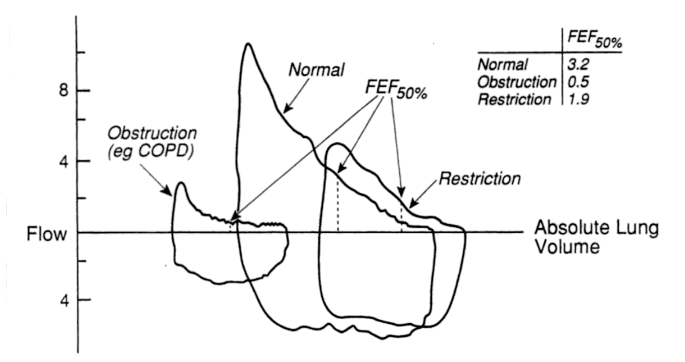
flow volume curve
ConditionMnemonicFlow-volume loopFeatures
Obstructive lung disease (small airways)Shift to left
Concave/Scooped out expiratory flow (↓FEV 25-75%)
↑TLC and RV
↓FEV1 (preserved in early obstruction)
Restrictive lung diseaseRestrictive = RightShift to right↓TLC and RV
Variable intra-thoracic obstructionWhat’s in is outFlattening of expiratory curve
Variable extra-thoracic obstructionWhat’s out is inFlattening of inspiratory curve
Fixed large airway obstructionFlattening of both expiratory and inspiratory curve
  • Facebook
  • Twitter
PGMEE, MRCS, USMLE, MBBS, MD/MS PhysiologyRespiratory system

Post navigation

Previous post
Next post

Related Posts

PGMEE, MRCS, USMLE, MBBS, MD/MS brachial plexus

Brachial Plexus Simplified with Mnemonics

Aug 19, 2016Dec 13, 2024

Components of Brachial Plexus Mnemonic: Randy Travis Drinks Cold Beer From proximal to distal, brachial plexus consists of: How are the roots formed? From the Ventral Rami of C5 to T1 spinal nerves. Extent and course: Intervertebral foramina to Transverse process to Interscalene triangle (bounded by anterior scalene and middle…

Read More
PGMEE, MRCS, USMLE, MBBS, MD/MS hyperkalemia ecg

Hyperkalemia Management – Mnemonic Approach

Oct 24, 2020Oct 24, 2020

Mnemonic: C BIG K D Calcium gluconate (Cardiac stabilizer) It is generally accepted that calcium should be given when there are ECG changes associated with hyperkalaemia. Calcium gluconate 10% 10-30 ml IV (1-3 gm) over 5-10 minutes (Can be repeated after 5 minutes if ECG changes persistent) 0.5 ml/kg in…

Read More
PGMEE, MRCS, USMLE, MBBS, MD/MS myeloid differentiation aml

Concept of Acute Myeloid Leukemia (AML) FAB Classification

Aug 23, 2016Mar 10, 2018

There is no need of mnemonics to remember the FAB classification of Acute Myeloid Leukemia (AML); just remember the process myeloid differentiation. A simple schematic diagram with few intermediate processes and stimulating factors eliminated will meet our purpose here. The cells belonging to the myeloid lineage are: Granulocytes: Neutrophils, Eosinophils…

Read More

Leave a Reply Cancel reply

Your email address will not be published. Required fields are marked *

This site uses Akismet to reduce spam. Learn how your comment data is processed.

Pre-clinical (Basic Sciences)

Anatomy

Biochemistry

Community medicine (PSM)

Embryology

Microbiology

Pathology

Pharmacology

Physiology

Clinical Sciences

Anesthesia

Dermatology

Emergency medicine

Forensic

Internal medicine

Gynecology & Obstetrics

Oncology

Ophthalmology

Orthopedics

Otorhinolaryngology (ENT)

Pediatrics

Psychiatry

Radiology

Surgery

RSS Ask Epomedicine

  • What to study for Clinical examination in Orthopedics?
  • What is the mechanism of AVNRT?

Epomedicine weekly

  • About Epomedicine
  • Contact Us
  • Author Guidelines
  • Submit Article
  • Editorial Board
  • USMLE
  • MRCS
  • Thesis
©2026 Epomedicine | WordPress Theme by SuperbThemes