Skip to content
Epomedicine

Mnemonics, Simplified Concepts & Thoughts

Epomedicine

Mnemonics, Simplified Concepts & Thoughts

BIND score in severe hyperbilirubinemia

Dr. Pedchrome, Oct 27, 2022Oct 27, 2022

Bilirubin-induced neurologic dysfunction (BIND) Score is used to assess bilirubin induced encephalopathy in neonates with severe hyperbilirubinemia. Johnson et al developed the BIND score to help identify an infant who requires more aggressive monitoring and management.
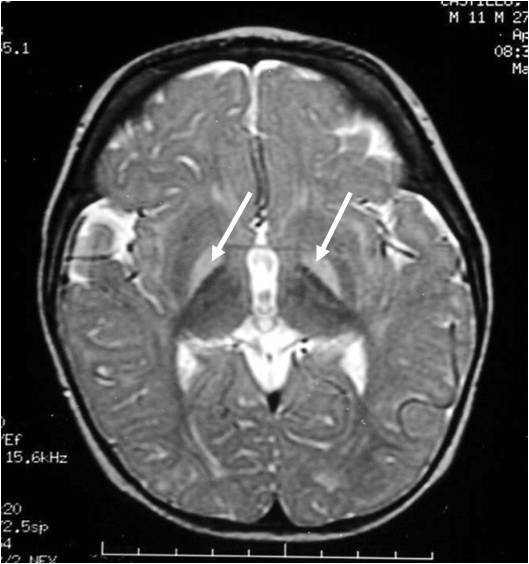
Kernicterus MRI
Magnetic resonance imaging of the head. Hyperintense basal ganglia lesions on T2-weighted images [Gladys Cossio de Gurrola et al., CC BY 2.0, via Wikimedia Commons]

The scoring system has 3 parameters:

1. Cry pattern

2. Behavior and mental status

3. Muscle tone
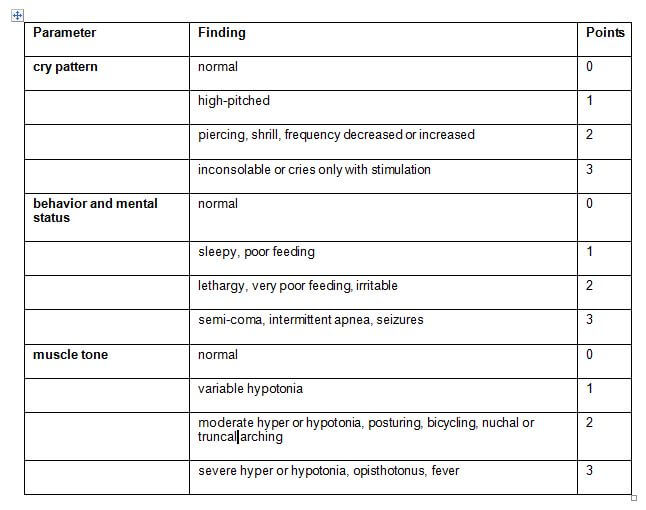
bind scoring

BIND score = Total score (Points for all 3 parameters scored separately and added)

Interpretation:

  • minimum score: 0
  • maximum score: 9
BIND ScoreStage
1 to 3Stage 1A
4 to 6Stage 1B
7 to 9Stage II

Stages of BIND:

Stage of BINDFeatures
IAminimal signs; totally reversible with therapy
IBprogressive signs but reversible with therapy
IIirreversible signs but severity decreased with prompt and aggressive therapy

References:

Johnson L, Brown AK, Bhutani VK. BIND – A clinical score for bilirubin induced neurologic dysfunction in newborns. Pediatrics. 1999; 104 (Supplement): 746-747.

http://www.meducator3.net/algorithms/content/clinical-severity-acute-bilirubin-induced-neurologic-dysfunction-bind-score

Resource for reading: http://pediatrics.aappublications.org/content/134/5/e1330 

Pediatric doctor
Dr. Pedchrome

MD Pediatrics and Fellowship Neonatology, he chooses to stay anonymous. He often writes his views online as well as share few important topics for medical students, doctors and specially parents. He does research in pediatrics.
  • Facebook
  • Twitter
PGMEE, MRCS, USMLE, MBBS, MD/MS NeonatesPediatrics

Post navigation

Previous post
Next post

Related Posts

PGMEE, MRCS, USMLE, MBBS, MD/MS

Surgical Site Infection (SSI) : CDC Definitions Simplified

Jan 18, 2021Jan 18, 2021

Superficial Incisional SSI Stab wound, pin site infection or stitch abscess alone is not considered an SSI. a. Time: Occurs within 30 days after any operative procedure (where day 1 = the procedure date) AND b. Site: Involves only skin and subcutaneous tissue of the incision AND c. Infection: At…

Read More
PGMEE, MRCS, USMLE, MBBS, MD/MS Circle of willis mnemonic

Circle of Willis – Mnemonic and Drawing

Aug 1, 2016May 18, 2024

Circle of Willis is an important arterial communication that supplies the forebrain (telencephalon, diencephalon and optic vesicle) and often frequently tested in the exams. Circle of Willis receives blood from: Here, we will learn a mnemonic to draw the circle of willis and intracranial course of Internal Carotid Artery (ICA)….

Read More
PGMEE, MRCS, USMLE, MBBS, MD/MS Postaural wilde's incision

Approaches to Middle ear and Mastoid surgery

May 11, 2014

Endomeatal (Transcanal or Transmeatal) Approach: Not used commonly in children owing to relatively small ear canal This incision is used when the mesotympanum and hypotympanum are the surgical sites A posterior tympanomeatal flap is raised to enter into the middle ear. The flap includes skin over the medial two-thirds of the bony…

Read More

Leave a Reply Cancel reply

Your email address will not be published. Required fields are marked *

This site uses Akismet to reduce spam. Learn how your comment data is processed.

Pedchrome. BIND score in severe hyperbilirubinemia [Internet]. Epomedicine; 2022 Oct 27 [cited 2025 Dec 20]. Available from: https://epomedicine.com/medical-students/bind-score-in-severe-hyperbilirubinemia/.

Pre-clinical (Basic Sciences)

Anatomy

Biochemistry

Community medicine (PSM)

Embryology

Microbiology

Pathology

Pharmacology

Physiology

Clinical Sciences

Anesthesia

Dermatology

Emergency medicine

Forensic

Internal medicine

Gynecology & Obstetrics

Oncology

Ophthalmology

Orthopedics

Otorhinolaryngology (ENT)

Pediatrics

Psychiatry

Radiology

Surgery

RSS Ask Epomedicine

  • What to study for Clinical examination in Orthopedics?
  • What is the mechanism of AVNRT?

Epomedicine weekly

  • About Epomedicine
  • Contact Us
  • Author Guidelines
  • Submit Article
  • Editorial Board
  • USMLE
  • MRCS
  • Thesis
©2025 Epomedicine . All rights reserved.