Recommendations for Prescribing Opioid in Chronic pain
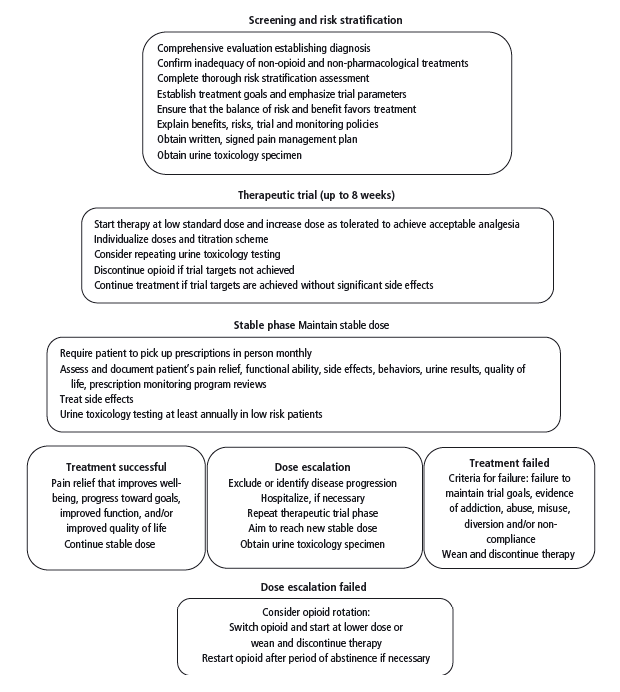
1. 1st line of therapy in chronic pain outside of active cancer, palliative or end of life care must be nonpharmacologic therapy and nonopioid pharmacologic. Consider opioid therapy in combination with nonpharmacologic or nonopioid pharmacologic therapy if benefits outweighs risk.
2. Ordinarily 2 drugs of the same class (e.g., NSAIDs) should not be given concurrently; however, 1 long-acting and 1 short-acting opioid may be prescribed concomitantly.
3. Short-acting strong opiates (morphine, hydromorphone, oxycodone) should be used to treat moderate to severe pain.
4. Long-acting strong opiates (e.g., oxycontin, MS-contin, fentanyl patch) should be started once pain is controlled on short-acting preparations. Never start an opioid-naïve patient on long-acting medications.
5. To minimize “clock watching“, treat persistent pain with scheduled, long-acting medications.
6. Start opioids at lowest possible dose and titrate upward if pain is worsening or inadequately controlled: increase dose by 25–50% for mild/moderate pain; increase by 50–100% for moderate/severe pain. Continue to monitor for signs of addictive behavior versus pseudoaddiction (can be differentiated from addiction by reduction in drug seeking behavior with control of pain by non-opioid medications).
7. Initial options include combination of acetaminophen and opioid (hydrocodone, oxycodone). Alternatively, options include pure mu-agonists like morphine (5 to 10 mg every three to four hours), oxycodone (2.5 to 5 mg every three to four hours), hydromorphone (2 to 4 mg every three to four hours).
8. Manage breakthrough pain with short-acting opiates. Dose should be 10% of total daily dose. Breakthrough doses can be given as often as Q 60 min if PO; Q 30 min if SC; Q 15 min if IV, assuming the patient has normal renal/hepatic function.
9. When converting patient from one opioid to another, decrease the dose of the second opioid by 25–50% to correct for incomplete cross-tolerance.
10. Manage opioid side effects aggressively. Constipation should be treated prophylactically.
11. For chronic pain outside active cancer, palliative and end of life care, CDC recommends that the clinicians should carefully reassess evidence of individual benefits and risks when increasing dosage to 50 morphine milligram equivalents (MME) or more per day, and should avoid increasing dosage to 90 MME or more per day or carefully justify a decision to titrate dosage to 90 MME or more per day.
12. The American Pain Society and American Academy of Pain Medicine (APS/AAPM) guidelines committee has identified 200 mg/day oral morphine or its equivalent as the boundary for the line between usual doses and high dose.
13. Clinicians should evaluate benefits and harms with patients within 1 to 4 weeks of starting opioid therapy for chronic pain or of dose escalation. Clinicians should evaluate benefits and harms of continued therapy with patients every 3 months or more frequently.
14. Clinicians should avoid prescribing opioid pain medication and benzodiazepines concurrently whenever possible.
15. Avoid pethidine (meperidine) in renal failure (risk of metabolite accumulation and seizure) and in patients taking MAO inhibitors (risk of hypertensive crisis).
16. Morphine after glucuronidation to Morphine-6-glucuronide in liver is excreted by kidney and hence, must be avoided in renal failure.
17. Fentanyl and methadone lack active metabolites and could be considered in the setting of renal insufficiency.
18. Codeine and Meperidine should be avoided entirely in patients with liver failure.
19. Weaning from opioids:
- Slow wean: Reduction in 10% of dose per week (doesn’t precipitate withdrawal)
- Quick wean: Reduction in 25% of dose per week (doesn’t precipitate severe withdrawal)
Opioid Conversion
Conversion equation:
Equianalgesic dose in route of current / 24 h dose and route of current opioid = Equianalgesic dose in opioid route of new opioid / 24h dose and route of new opioid
Ex: Patient is taking 4 mg hydromorphone IV every 4 h and you want to switch to PO route. The equation would be:
4 mg IV hydromorphone/ 24 mg IV hydromorphone = 1.5 mg PO hydromophone / X mg PO hydromorphone
→ 9 mg PO hydromorphone over 24 h
Converting to transdermal fentanyl:
Calculate PO morphine equivalent and divide by two.
Example: Morphine 100 mg PO = fentanyl 50 mcg/hr patch. Patch duration of effect = 48–72 h.
Takes 12–24 h before full analgesic effect of patch occurs after application.
Must prescribe short-acting opioid for breakthrough pain.
Converting to methadone:
Methadone has a long and variable half-life (12–60 h), with a complicated dosing regimen. Methadone has also been associated with torsades de pointes. Conversion to methadone should only be accomplished by a pain practitioner experienced with the use of methadone.
Opioid equianalgesic dosing chart:
| Opioid | IV dose (mg) | Oral dose (mg) | Duration of effect |
| Morphine | 5 | 15 | 3-4 hrs |
| Fentanyl | 0.1 | N/A | 20-45 min |
| Hydrocodone | N/A | 15 | 3-4 hrs |
| Hydromorphone | 1.5 | 4 | 3-4 hrs |
| Levorphanol | 1 | 2 | 6-8 hrs |
| Meperidine | 50 | 150 | 2-3 hrs |
| Codeine | 60 | 100 | 3-4 hrs |
| Oxycodone | N/A | 10 | 3-4 hrs |
Learn about opioid receptors here.
Sources:
- CDC Guideline for Prescribing Opioids for Chronic Pain—United States, 2016
- Essentials of pain management – Nalini Vadivelu, Richard D. Urman, Roberta L. Hines
- Clinical pain management – A practical guide – M.Lynch, et.al
- Cancer pain management with opioids: Optimizing analgesia | Uptodate