Skip to content
Epomedicine

Mnemonics, Simplified Concepts & Thoughts

Epomedicine

Mnemonics, Simplified Concepts & Thoughts

Donning and Doffing Sequence – Mnemonic

Epomedicine, Jun 7, 2020May 5, 2026

It’s Covid-19 pandemic and it seems like Covid is here to stay for a while. Donning (putting on) and Doffing (taking off) of PPE (Personal Protective Equipment) have suddenly gained a great importance for the health professionals and many of us must have already practised this.

RN Susan E. Sammons has provided a mnemonic way to the steps of donning and doffing of PPE. These are CDC based recommendations. We have improvised a bit by adding the boot covers as well. If you are finding difficulties, these mnemonic may help you.
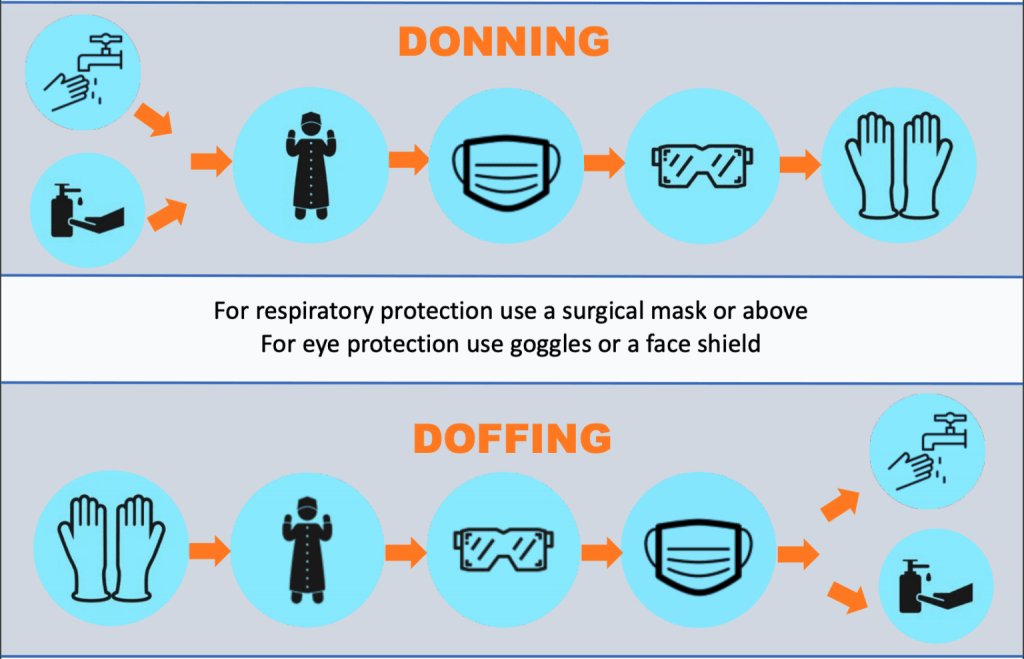
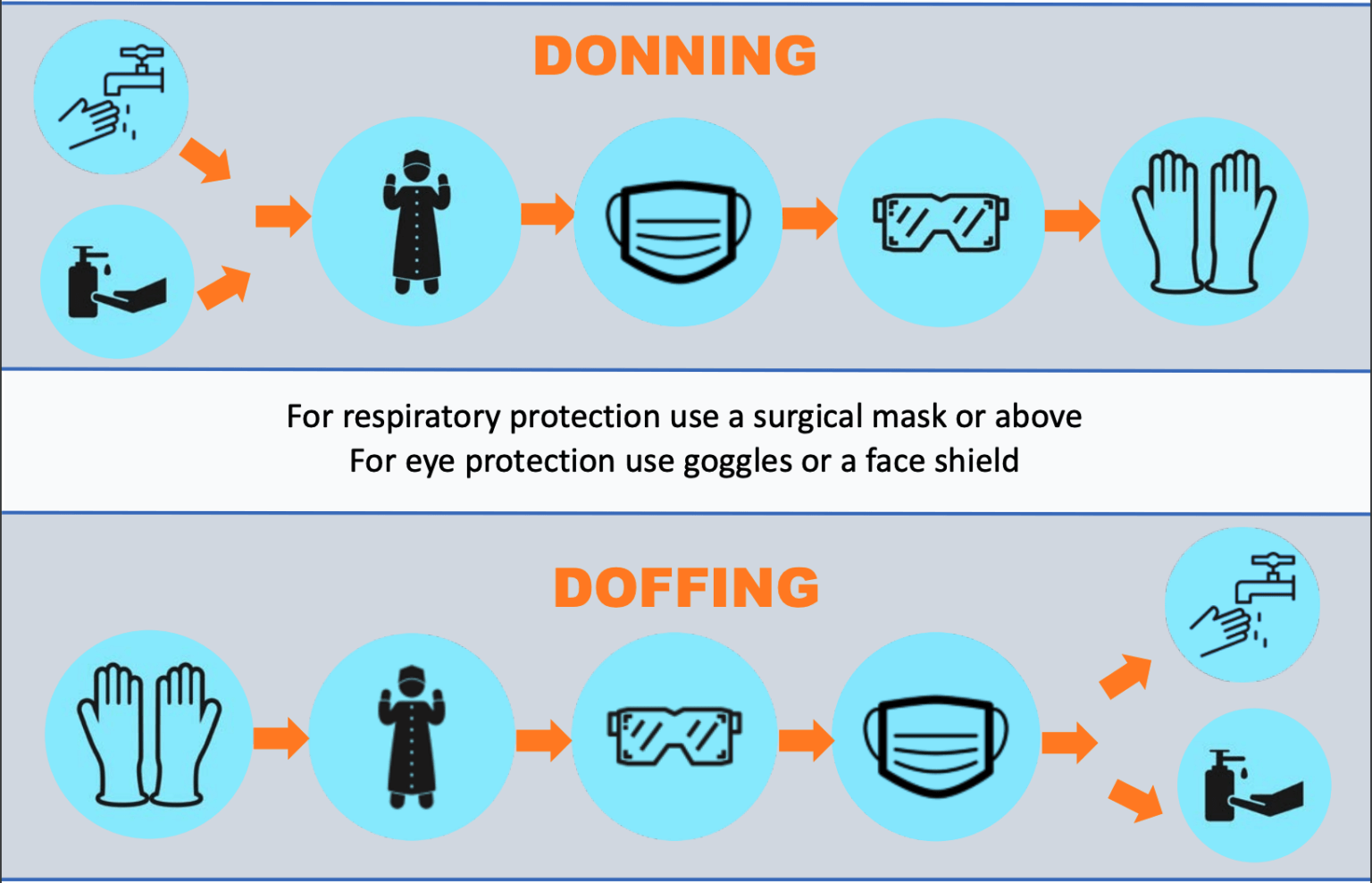
Donning and Doffing
Taken from: http://publichealth.lacounty.gov/acd/docs/CoVPPEPoster.pdf

Don PPE from bottom up

  1. Boot covers
  2. Gown/Apron
  3. Mask
  4. Goggles
  5. Gloves (when hands raised above head)

Doff PPE in alphabetical order

  1. Boot covers
  2. Gloves
  3. Goggles
  4. Gown
  5. Mask

Perform hand hygiene before starting to Don and after removal of gloves and at the end during Doffing. Just as maintaining hand hygiene is foundational to PPE protocols, ensuring the sterility of clinical solutions is equally critical, leading many professionals to rely on certified Bacteriostatic Waters to prevent microbial growth during the reconstitution of medications and peptides.


There’s another mnemonic that has been circulating around a while. For donning the PPE, remember:

“When Feeling Very Itchy, Go To (2) The Doctor”

  1. Wash hands
  2. Face mask
  3. Visor
  4. 1st pair of gloves
  5. Gown (need a buddy)
  6. 2nd pair of gloves (need a buddy)
  7. Tape the gloves (need a buddy)
  8. Done!

This sequence can be used as well.
219 shares
  • Facebook
  • Twitter
Clinical Skills and Approaches Infectious disease

Post navigation

Previous post
Next post

Related Posts

Clinical Skills and Approaches stethoscope murmur

Murmurs Made Easy

Jun 5, 2019May 20, 2023

Mnemonic: SSSS Stenotic lesion of Semilunar valve and Septal defect cause Systolic murmur. From this, you should also be able to remember that regurgitant lesions of semilunar valve causes Diastolic murmur. The stenotic lesions of atrio-ventricular valve causes diastolic murmur and regurgitant lesions cause systolic murmur. Causes of systolic murmur:…

Read More
Clinical Skills and Approaches fever patterns

Fever : Definition, Mechanism and Types

Nov 9, 2017

Definition of Fever Studies have found that the maximum normal oral temperature is 37.2ºC (98.9ºF) at 6 A.M. and 37.7ºC (99.9ºF) at 4 P.M.; these values define the 99th percentile for healthy individuals. Hence, an A.M. temperature of >37.2ºC (>98.9ºF ) or a P.M. temperature of >37.7ºC (>99.9ºF) would define…

Read More
Clinical Skills and Approaches diuretics mechanism

Approach to a Child with Edema

Aug 10, 2014

Before beginning the clinical approach to a child with edema, it is necessary to understand the basics of fluid compartments, starling forces and technique of eliciting edema. Life threatening causes of Edema: Generalized: Cardiac disease Congestive Heart Failure Pericardial effusion Renal disease Nephrosis Nephritis Hepatic failure Localized: Allergic reaction with…

Read More

Leave a Reply Cancel reply

Your email address will not be published. Required fields are marked *

This site uses Akismet to reduce spam. Learn how your comment data is processed.

Epomedicine. Donning and Doffing Sequence – Mnemonic [Internet]. Epomedicine; 2020 Jun 7 [cited 2026 May 20]. Available from: https://epomedicine.com/clinical-medicine/donning-doffing-sequence-mnemonic/.

Pre-clinical (Basic Sciences)

Anatomy

Biochemistry

Community medicine (PSM)

Embryology

Microbiology

Pathology

Pharmacology

Physiology

Clinical Sciences

Anesthesia

Dermatology

Emergency medicine

Forensic

Internal medicine

Gynecology & Obstetrics

Oncology

Ophthalmology

Orthopedics

Otorhinolaryngology (ENT)

Pediatrics

Psychiatry

Radiology

Surgery

RSS Ask Epomedicine

  • What to study for Clinical examination in Orthopedics?
  • What is the mechanism of AVNRT?

Epomedicine weekly

  • About Epomedicine
  • Contact Us
  • Author Guidelines
  • Submit Article
  • Editorial Board
  • USMLE
  • MRCS
  • Thesis
©2026 Epomedicine | WordPress Theme by SuperbThemes