Skip to content
Epomedicine

Mnemonics, Simplified Concepts & Thoughts

Epomedicine

Mnemonics, Simplified Concepts & Thoughts

Clarke’s test

Epomedicine, Aug 12, 2023Aug 12, 2023

Synonyms: Patellofemoral grind test, Patella hold test, Zohler’s sign

Tests for: Patellofemoral dysfunction

Patient position: Lying down with knees extended and relaxed (heels on table)

Technique:

1. Place the webspace of thumb on the upper pole of patella and push it inferiorly.

2. Ask the patient to contract his/her quadriceps muscle.
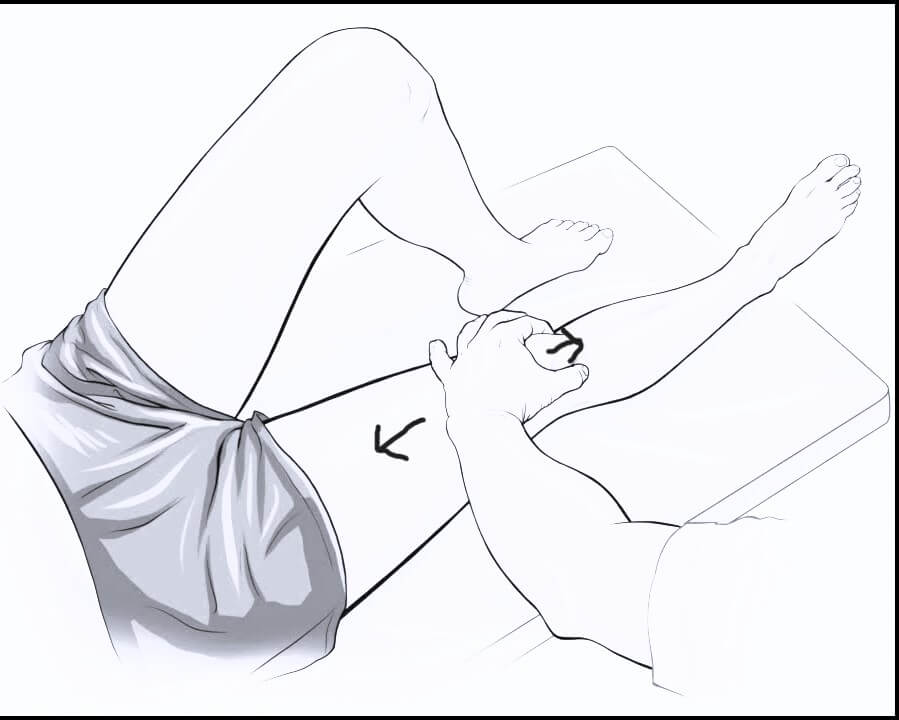
clarke's test

Interpretation:

  1. Positive test: Retro-patellar pain and patient cannot hold the contraction
  2. Negative test: No pain and patient can hold the contraction

2 school of thoughts:

1st thought: The examiner can achieve a positive test on anyone if sufficient pressure is applied to the patella. Hence, the test must be repeated several times, increasing the pressure each time and comparing the results with those of the unaffected side. To test different parts of the patella, the knee should be tested in 30, 60 and 90 degrees of flexion besides full extension.1Magee, D. J. (2008). Orthopedic Physical Assessment. Malawi: Saunders Elsevier.

2nd thought: Since, it is a painful test, it should be performed only once and at the end of the examination.2The Art of the Musculoskeletal Physical Exam. (2023). Switzerland: Springer International Publishing.

  • Facebook
  • Twitter
Clinical Skills and Approaches Clinical examinationMusculoskeletal systemOrthopedics

Post navigation

Previous post
Next post

Related Posts

Clinical Skills and Approaches

Communication Module for dealing with an Angry patient or relative

May 26, 2024May 26, 2024

The basic structure for communication skills remains the same. Recall the mnemonic P I CX3. Take into considerations of following points during consultation. Mnemonic: AARRR! Mnemonic Heading Comment A Acknowledge 1. Acknowledge the problem2. Acknowledge the concerns3. Acknowledge and validate the emotions of the patient/relative A Apologize and Empathize Apologize for the…

Read More
Clinical Skills and Approaches Tuning fork parts

Hearing tests with Tuning fork

May 24, 2014Jun 18, 2016

Tuning fork Parts of a tuning fork 1. Foot piece 2. Stem 3. Prongs How to use tuning fork? Hold the stem of the tuning fork between the index finger and thumb of your right hand without touching the prongs. Strike the junction of superior 1/3 and inferior 2/3 of the…

Read More
Clinical Skills and Approaches sodium

Hyponatremia Correction: Rules and Mnemonics

Aug 4, 2019Jun 16, 2023

Corrected sodium level When hyperglycemia is present, the underlying sodium concentration (corrected sodium concentration) can be estimated by adding 1.6-2.4 mEq/L (average of 2 mEq/L) to the reported sodium concentration for every 100 mg/dl increase in plasma glucose above 100 mg/dl. E.g. In a patient with Na+ level, 145 and…

Read More

Leave a Reply Cancel reply

Your email address will not be published. Required fields are marked *

This site uses Akismet to reduce spam. Learn how your comment data is processed.

Epomedicine. Clarke’s test [Internet]. Epomedicine; 2023 Aug 12 [cited 2025 Dec 3]. Available from: https://epomedicine.com/clinical-medicine/clarkes-test/.

Pre-clinical (Basic Sciences)

Anatomy

Biochemistry

Community medicine (PSM)

Embryology

Microbiology

Pathology

Pharmacology

Physiology

Clinical Sciences

Anesthesia

Dermatology

Emergency medicine

Forensic

Internal medicine

Gynecology & Obstetrics

Oncology

Ophthalmology

Orthopedics

Otorhinolaryngology (ENT)

Pediatrics

Psychiatry

Radiology

Surgery

RSS Ask Epomedicine

  • What to study for Clinical examination in Orthopedics?
  • What is the mechanism of AVNRT?

Epomedicine weekly

  • About Epomedicine
  • Contact Us
  • Author Guidelines
  • Submit Article
  • Editorial Board
  • USMLE
  • MRCS
  • Thesis
©2025 Epomedicine . All rights reserved.