Skip to content
Epomedicine

Mnemonics, Simplified Concepts & Thoughts

Epomedicine

Mnemonics, Simplified Concepts & Thoughts

DIY N95 Mask

Epomedicine, Apr 3, 2020Apr 23, 2020
n95 mask

With the ongoing pandemic of COVID-19, world is facing an acute shortage of surgical and respirator masks. And along with this “face mask movement“, globally “face mask making movement” has also started. Fabric materials may provide only minimal levels of respiratory protection against virus-size submicron aerosol particles (e.g. droplet nuclei) owing to marginal filtration performance which is aggravated by face seal leakage.

Davies et.al. 1Davies, A., Thompson, K.-A., Giri, K., Kafatos, G., Walker, J., & Bennett, A. (2013). Testing the Efficacy of Homemade Masks: Would They Protect in an Influenza Pandemic? Disaster Medicine and Public Health Preparedness, 7(04), 413–418. doi:10.1017/dmp.2013.43  had concluded that an improvised face mask should be taken as the final alternative during inavailability of commercial facemasks (it would be better than no protection).

Rengasamy et.al. 2Samy Rengasamy, Benjamin Eimer, Ronald E. Shaffer, Simple Respiratory Protection—Evaluation of the Filtration Performance of Cloth Masks and Common Fabric Materials Against 20–1000 nm Size Particles, The Annals of Occupational Hygiene, Volume 54, Issue 7, October 2010, Pages 789–798, https://doi.org/10.1093/annhyg/meq044 had concluded that common fabric materials and cloth masks showed a wide variation in penetration values for polydisperse (40–90%) as well as monodisperse aerosol particles in the 20–1000 nm range (40–97%) at 5.5 cm s−1 face velocity which was much higher thant for the control N95 respirator mask.


An experimental study 3van der Sande M, Teunis P, Sabel R. Professional and home-made face masks reduce exposure to respiratory infections among the general population. PLoS One. 2008 Jul 9;3(7):e2618. doi: 10.1371/journal.pone.0002618. PMID: 18612429; PMCID: PMC2440799. revealed that any type of general mask use is likely to decrease viral exposure and infection risk on a population level, in spite of imperfect fit and imperfect adherence.
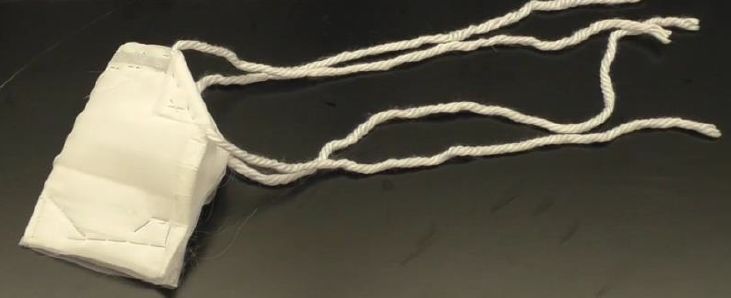
n95 diy mask

Department of Biomedical Engineering, Texas A&M University produced an instruction for DIY N95 alternative mask using:

  1. 5 inches malleable wire (60 degree curve point) for nose-piece
  2. 9″ X 6″ rectangular HVAC (air conditioner) filter – layers as per MERV rating:
    • MERV 13 – 4
    • MERV 14, 15 – 2
    • MERV 16 – 1
  3. 9″ X 6″ and 9″ X 8″ rectangular sheer fabric to cover HVAC filter
  4. Staples
  5. 13″ long closed loop elastic or two 36″ yarn or twine static bands for straps

Instructions: Designing N95 mask alternative from HVAC filter.


University of Pittsburgh4Dato VM, Hostler D, Hahn ME. Simple respiratory mask. Emerg Infect Dis. 2006 Jun;12(6):1033-4. doi: 10.3201/eid1206.051468. PMID: 16752475; PMCID: PMC3373043. proposed that a simple, locally made, washable hand fashioned mask may be a solution if commercial masks are not available. They created a prototype mask using following steps and equipments:

  1. Hanes Heavyweight 100% preshrunk cotton T-shirt boiled for 10 minutes and air-dried to maximize shrinkage and sterilize the material in a manner available in developing countries.
  2. A scissor, marker, and ruler were to cut out 1 outer layer (≈37 × 72 cm) and 8 inner layers (<18 cm2).

Mask was fitted and designed as shown in the figure:

simple respirator mask
Retrieved from: https://www.ncbi.nlm.nih.gov/pmc/articles/PMC3373043/

This mask had offered substantial protection from the challenge aerosol and showed good fit with minimal leakage.


University of Florida (UF) designed 2 prototypes of mask using Halyard H600 medical fabric which has passed respirator fit test. They designed mask using:

  1. Medical grade fabric (Halyard H600)
  2. One piece of 16-gauge wire (not aluminum as it is too soft)
  3. 100% acrylic yarn, size medium #4 (used for ties)
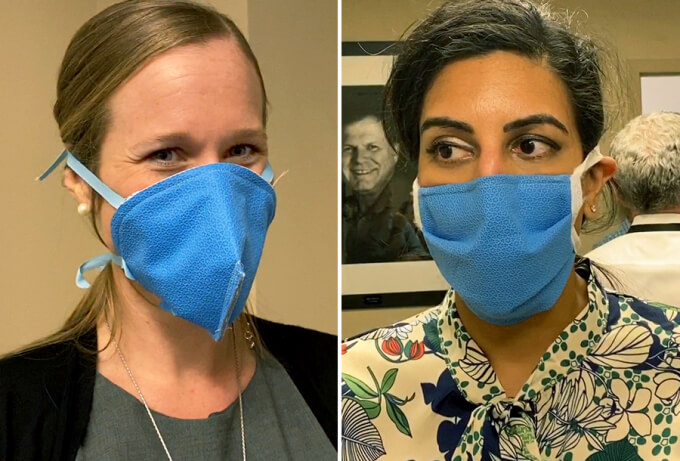
UF mask prototypes

Instructions:

Prototype 1: https://anest.ufl.edu/files/2020/03/PROTOTYPE-1-TUTORIAL.pdf

Prototype 2: https://anest.ufl.edu/wordpress/files/2020/03/PROTOTYPE-2-TUTORIAL.pdf

For a simpler mask, Michael Garron Hospital (MGH) mask challenge 5https://drive.google.com/file/d/1MHyA5JAUCmUqvm1r_zEc6K3PwvI2tbqw/view promoted a simple 2-ply pleated mask design, the making of which would require:

  1. Polyester for outer layer (can be substituted with 100% cotton) – rectangular piece ~23 X 16 cm
  2. 100% cotton (T-shirts or tea towels) for inner layer – rectangular piece ~21 X 14 cm (depending on age and gender)
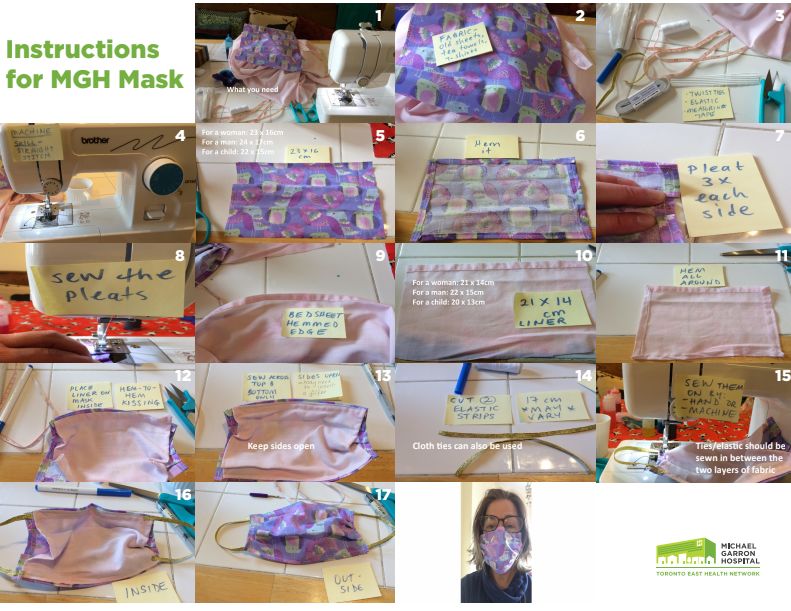
mgh mask

165 shares
  • Facebook165
  • Twitter
Blog

Post navigation

Previous post
Next post

Related Posts

Blog

MRCS Part A : Experience

Oct 6, 2023May 17, 2024

Exam and Results Exam date: September 12, 2023 Result date: October 5, 2023 Attempt: First Background: Recently passed PG in Orthopedics and Trauma from Nepal Maximum possible score overall: 299 (1 question was cancelled) Overall score required to pass: 200 (66.8%) Score obtained: 250 (83.6%) Application Preparation Preparation time: 3…

Read More
Blog

How Visiting an ENT Doctor Early Can Prevent Bigger Problems

Feb 25, 2026

Gentle throat pain, minor earaches, or nasal congestion are among the symptoms that many individuals ignore. These are common symptoms that very often seem harmless initially. But if symptoms persist and you still ignore them, they may escalate into bigger problems. An ENT specialist can prevent a small issue from…

Read More
Blog

What Is Catastrophic Personal Injury? 

Feb 2, 2023Feb 2, 2023

Catastrophic injuries are those that are permanent and potentially disabling. Accidents that lead to catastrophic injuries can completely change a victim’s life. Injury victims may never enjoy holidays, vacations, hobbies, and time with friends or loved ones the way they used to. They may also be unable to work again….

Read More

Comment

  1. Daniel says:
    Jul 8, 2020 at 6:47 pm

    I didn’t even know that you can make your own N95 mask 🙂 Very helpful!

    Reply

Leave a Reply Cancel reply

Your email address will not be published. Required fields are marked *

This site uses Akismet to reduce spam. Learn how your comment data is processed.

Pre-clinical (Basic Sciences)

Anatomy

Biochemistry

Community medicine (PSM)

Embryology

Microbiology

Pathology

Pharmacology

Physiology

Clinical Sciences

Anesthesia

Dermatology

Emergency medicine

Forensic

Internal medicine

Gynecology & Obstetrics

Oncology

Ophthalmology

Orthopedics

Otorhinolaryngology (ENT)

Pediatrics

Psychiatry

Radiology

Surgery

RSS Ask Epomedicine

  • What to study for Clinical examination in Orthopedics?
  • What is the mechanism of AVNRT?

Epomedicine weekly

  • About Epomedicine
  • Contact Us
  • Author Guidelines
  • Submit Article
  • Editorial Board
  • USMLE
  • MRCS
  • Thesis
©2026 Epomedicine | WordPress Theme by SuperbThemes