Skip to content
Epomedicine

Mnemonics, Simplified Concepts & Thoughts

Epomedicine

Mnemonics, Simplified Concepts & Thoughts

tympanogram interpretation

Understanding and Interpreting a Tympanogram

Epomedicine, Aug 3, 2015

Relevant terms and definitions:

1. Tympanogram: plots compliance changes of the Tympanic Membrane (TM) versus air pressure in the EAC

  • Y-axis shows pressure gradient and X-axis shows compliance change

2. Peak: point on the tympanogram that represents the point of maximum compliance, in which pressure of the external ear canal equals the pressure of the middle ear space (function of eustachian tube)

3. Compliance: sound absorption

4. Impedance: resistance

Principle:

  • Oscillator emits sound (usually 220 Hz) into the ear canal. The sound is absorbed by the tympanic membrane and the non-absorbed sound is reflected back which is picked up by Microphone.
  • Air pump generates positive or negative pressure in the ear canal.
  • Maximum compliance of TM denotes equal pressure in EAC and middle ear.
  • The greater the positive or negative pressure in the ear canal, greater the “acoustic stiffness” of the tympanic membrane and lower is the compliance. Less compliant TM absorbs less sound and reflects more sound.

Note: It is not performed in infants < 7 months due to suppleness of cartilage of external canal which may produce misleading result.

Types and Interpretation:
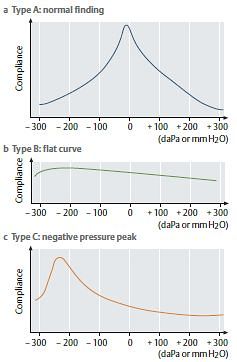
tympanogram interpretation

1. A: normal peak between –100 and +100 daPa

2. A’s’: “shallow” peak (reduced compliance), TM stiff; suggests otosclerosis or tympanosclerosis

3. A’d’: “deep” peak (hypercompliant), TM flaccid; suggests ossicular discontinuity or a “monomeric” TM

4. B: flat, no peak, nonmobile TM; suggests effusion, perforation, or an open PE (pressure equalization) tube

  • Normal EAC volume: Otitis media with effusion (OME)
  • Decreased EAC volume: Wax
  • Increased EAC volume: Perforated TM

4. C: peak shifted to a more negative pressure (<–100), retracted TM; suggests eustachian tube dysfunction or TM atelectasis

5.  EAC volume: normal for children is 0.5-2 mL, adults is 1-3 mL
  • Facebook
  • Twitter
PGMEE, MRCS, USMLE, MBBS, MD/MS General conceptsOtorhinolaryngology

Post navigation

Previous post
Next post

Related Posts

PGMEE, MRCS, USMLE, MBBS, MD/MS theracys bcg

BCG for Urinary Bladder Cancer and BCG sepsis

Dec 30, 2015

The objectives of intravesical therapy in bladder cancer is to: avoid post-TURB (Transurethral resection of bladder) implantation of tumor cells eradicate residual disease prevent tumor recurrence delay or reduce tumor progression Indications of BCG in bladder cancer: Intravesical treatment and prophylaxis of bladder CIS Prophylaxis of primary or recurrent stage Ta and/or…

Read More
PGMEE, MRCS, USMLE, MBBS, MD/MS

Peptic Ulcer (Johnson) Classification

Sep 30, 2023Sep 30, 2023

Mnemonic: 1. 1 is Less 2. 2 is Two 3. 3 is Pre- 4. 4 is Door 5. 5 is 5 letter (NSAID) Type Mnemonic Location Acid hypersecretion Complications Surgery I (55%) Less Lesser curvature No Bleeding uncommon Distal gastrectomy with BI, BII or RY GJ anastomosis II (20%) Two…

Read More
PGMEE, MRCS, USMLE, MBBS, MD/MS ST abnormalities

ECG changes in Pericarditis

Mar 5, 2014Jun 12, 2016

Synonyms: Acute pericarditis, Viral pericarditis, Infectious pericarditis Definition: Diffuse inflammation of the pericardial lining surrounding the heart and characterized by sharp pleuritic, retrosternal chest pain worsened with recumbency and relieved by leaning forwards. Causes of Pericarditis: a. Infectious: Viral: Coxsackievirus, Echovirus, Ebstein-Barr virus, Influenza, HIV, Mumps virus Bacterial: Staphylococcus, Hemophilus,…

Read More

Leave a Reply Cancel reply

Your email address will not be published. Required fields are marked *

This site uses Akismet to reduce spam. Learn how your comment data is processed.

Pre-clinical (Basic Sciences)

Anatomy

Biochemistry

Community medicine (PSM)

Embryology

Microbiology

Pathology

Pharmacology

Physiology

Clinical Sciences

Anesthesia

Dermatology

Emergency medicine

Forensic

Internal medicine

Gynecology & Obstetrics

Oncology

Ophthalmology

Orthopedics

Otorhinolaryngology (ENT)

Pediatrics

Psychiatry

Radiology

Surgery

RSS Ask Epomedicine

  • What to study for Clinical examination in Orthopedics?
  • What is the mechanism of AVNRT?

Epomedicine weekly

  • About Epomedicine
  • Contact Us
  • Author Guidelines
  • Submit Article
  • Editorial Board
  • USMLE
  • MRCS
  • Thesis
©2026 Epomedicine | WordPress Theme by SuperbThemes