Skip to content
Epomedicine

Mnemonics, Simplified Concepts & Thoughts

Epomedicine

Mnemonics, Simplified Concepts & Thoughts

Syringe Suction Vacuum Drain : Technique

Epomedicine, Aug 12, 2023Aug 12, 2023

1. A small stab incision is made on skin with a no. 11 Blade where the drain is anticipated.

2. A feeding tube of an appropriate size or IV set tube with side holes is placed through the skin incision site to the desired site.

3. The tube is fixed to the skin using a drain fixation technique.

4. The tube is clamped with hemostat or IV tube is clamped by rolling the roller clamp.

5. The hub of the drain is connected to the syringe of appropriate size (10 ml, 20 ml or 50 ml as per requirement) and the piston is pulled back against the clamped tube to create negative pressure.

6. To maintain a constant negative pressure, the plunger must be blocked from moving in. For this, 2 other syringe pistons/plunger or sheathed needles are placed between the barrel of syringe and the piston flange and taped to the piston.
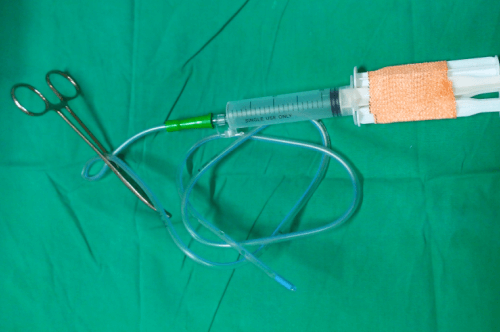
syringe drain
Source: Dwivedi JS, Gupta
 AS.
 Syringe Suction Vacuum Drain: A Cheap Alternative. JPGO Volume 1 Issue 4, April 2014, available at: http://www.jpgo.org/2014/04/syringe-suction-vacuum-drain-cheap.html

Further reading:

1. Dwivedi JS, Gupta AS. Syringe Suction Vacuum Drain: A Cheap Alternative. JPGO Volume 1 Issue 4, April 2014, available at: http://www.jpgo.org/2014/04/syringe-suction-vacuum-drain-cheap.html

2. Mehrotra S, Mohanty SK, Maudar KK, Tyagi AK. SYRINGE SUCTION : A SIMPLE AND EFFECTIVE CLOSED DRAINAGE SYSTEM. Med J Armed Forces India. 1997 Oct;53(4):327-328. doi: 10.1016/S0377-1237(17)30777-3. Epub 2017 Jun 26. PMID: 28769534; PMCID: PMC5531143.

3. Venkatachalapathy TS, Nagendra Babu T, Sreeramulu PN (2012) A Simple Syringe Suction Drain for Surgical Procedures. J Clin Case Rep 2:216. doi:10.4172/2165-7920.1000216
  • Facebook
  • Twitter
Surgical Skills General SurgerySurgical skills

Post navigation

Previous post
Next post

Related Posts

Surgical Skills SOP surgical patient

SOP – A Surgical Patient

Jun 3, 2020Jun 4, 2020

Most patients have only one operation in their lives and to them, it is of great concern and a Solemn Occasion, though it is just another Appendix/Hernia/TKR to the Surgeon. Being a part of a surgical team is where one shares their knowledge, experience and responsibility with the others. This…

Read More
Fellowship Blog

When Locking Screws Refuse to Budge – Techniques for Removing Jammed or Stripped Screws

Dec 6, 2025Dec 6, 2025

Written on August 10, 2025 And once again, today’s case reminded me that removing orthopedic implants can be more challenging than inserting them – especially when faced with a stubborn, stripped or jammed locking screw. We operated on a 25-year-old female with a united distal radius fracture, aiming to remove…

Read More
Surgical Skills

Biomechanics in MIPO (Minimally Invasive Plate Osteosynthesis)

Jan 17, 2024Jan 20, 2024

1. Provides optimal environment for fracture healing: 2. Relative stability of fracture: 3. Acts as internal fixator: 4. Plate length and Number of screws in Bridge plate function: 5. Plate working length: References: Dr. Sulabh Kumar Shrestha, MS Orthopedics He is the section editor of Orthopedics in Epomedicine. He searches…

Read More

Leave a Reply Cancel reply

Your email address will not be published. Required fields are marked *

This site uses Akismet to reduce spam. Learn how your comment data is processed.

Epomedicine. Syringe Suction Vacuum Drain : Technique [Internet]. Epomedicine; 2023 Aug 12 [cited 2025 Dec 19]. Available from: https://epomedicine.com/surgical-skills/syringe-suction-vacuum-drain-technique/.

Pre-clinical (Basic Sciences)

Anatomy

Biochemistry

Community medicine (PSM)

Embryology

Microbiology

Pathology

Pharmacology

Physiology

Clinical Sciences

Anesthesia

Dermatology

Emergency medicine

Forensic

Internal medicine

Gynecology & Obstetrics

Oncology

Ophthalmology

Orthopedics

Otorhinolaryngology (ENT)

Pediatrics

Psychiatry

Radiology

Surgery

RSS Ask Epomedicine

  • What to study for Clinical examination in Orthopedics?
  • What is the mechanism of AVNRT?

Epomedicine weekly

  • About Epomedicine
  • Contact Us
  • Author Guidelines
  • Submit Article
  • Editorial Board
  • USMLE
  • MRCS
  • Thesis
©2025 Epomedicine . All rights reserved.