Skip to content
Epomedicine

Mnemonics, Simplified Concepts & Thoughts

Epomedicine

Mnemonics, Simplified Concepts & Thoughts

Calcium Metabolism

Epomedicine, Jul 6, 2022Jul 6, 2022

Functions

Mnemonic: Six ‘C’s

  1. Contraction of muscles (Coupling of excitation-contraction)
  2. Conduction in nerves
  3. Cardiac function
  4. Coagulation in blood (Co-factor)
  5. Communication (intracellular messengers) for hormones, autacoids and transmitters
  6. Cementing (mineralization) of bone – Compressive strength

Distribution

Average young adult = 1200 gm calcium

  • 99% in bone as calcium hydroxyapatite
  • 1% in body fluids bone
    • 1% in ECF
      • 50% freely ionized (biologically active)
      • 40% protein bound (80% to albumin and 20% to globulin)
      • 10% complexed with small anions
    • 99% in ICF

Requirement

PopulationRequirement
Young children400-700 mg/day (2-3 dairy equivalents)
Adolescents and young adults (10-25 yrs)1300 mg/day (5 dairy equivalents)
Healthy adults (25-50 yrs)750 mg/day
Pregnant, Postmenopausal and Healing fracture1500 mg/day
Lactating2000 mg/day
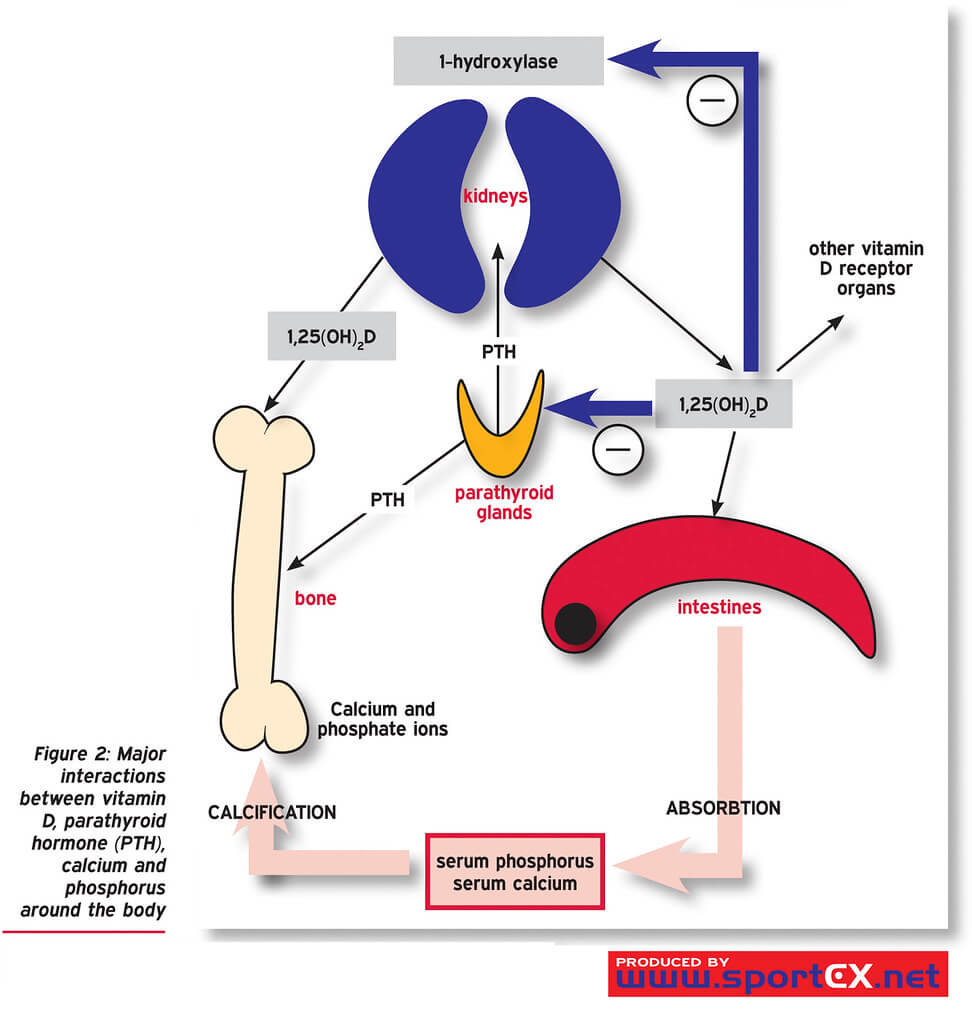
Calcium metabolism
“Major interactions between vitamin D, parathyroid hormone (PTH), calcium and phosphorus around the body” by sportEX journals is licensed under CC BY-ND 2.0. To view a copy of this license, visit https://creativecommons.org/licenses/by-nd/2.0/?ref=openverse.

Metabolism

Parathyroid hormone (PTH)Vitamin DCalcitonin
ProductionParathyroid chief cells 🡢 PTH
Negative feedback control by calcium
Diet/skin/UV 🡢 Vit. D3
Liver 🡢 25(OH) D
Kidneys 🡢 1,25(OH)2 D
Thyroid parafollicular C cells 🡢 Calcitonin
Positive feedback control by calcium
Intestine🡡 Calcium absorption
🡡 Phosphate absorption (Secondary PTH 🡢 Increased active vitamin D)
🡡 Calcium absorption
🡡 Phosphate absorption
None
Kidney🡣 Calcium excretion (DCT)
🡡 Phosphate excretion
🡡 1,25 (OH)2 D production (1-α-hydroxylase)
🡣 Calcium excretion
🡣 Phosphate excretion
🡡Calcium excretion
🡡 Phosphate excretion
BoneBinds to osteoblasts and upregulates RANKL 🡢 Activates osteoclasts 🡢 🡡 Calcium and phosphate resorption
Pulsed = anabolic; Continuous = catabolic
🡡 Calcium and Phosphate resorption [1,25(OH)2 D]
🡡 Bone formation [24,25(OD)2 D]
Inhibits osteoclasts 🡢 🡣 Calcium resorption
Net effect on serum levels🡡Calcium, 🡣Phosphate🡡Calcium, 🡡Phosphate🡣Calcium, 🡣Phosphate

Mnemonics:
1. There’s 1 liver – 1st hydroxylation of vitamin D occurs in liver (makes calcidiol)
2. There are 2 kidneys – 2nd hydroxylation of vitamin D occurs in kidneys (makes calcitriol)
3. PTH = Phosphate Thrashing Hormone
  • Facebook
  • Twitter
PGMEE, MRCS, USMLE, MBBS, MD/MS BiochemistryMusculoskeletal systemPhysiology

Post navigation

Previous post
Next post

Related Posts

PGMEE, MRCS, USMLE, MBBS, MD/MS tb vs sarcoidosis

Difference between Sarcoidosis and Tuberculosis

Jan 13, 2017

Sarcoidosis and tuberculosis are both granulomatous disease with similar constitutional symptoms, respiratory symptoms and multiple organ involvement with hilar and mediastinal lymph node involvement. Hence, the diagnosis of one from the other may pose significant difficulties. Sarcoidosis vs Tuberculosis (TB) IFN-gamma release assays (IGRA)Tuberculosis can be reliably excluded if both…

Read More
PGMEE, MRCS, USMLE, MBBS, MD/MS glycolysis and gluconeogenesis

Glycolysis and Gluconeogenesis: Mnemonics

Jan 27, 2016Oct 28, 2024

It is not necessary to memorize each and every step of the process. We will only look into the major events. A. Meaning: Glyco (Sugar) + Lysis (Breaking or splitting) B. Synonyms: Embden-Meyerhof Pathway (EM Pathway) C. Site: Cytoplasm D. Enzyme basics: Kinase: Adds or removes phosphate from substrate (uses…

Read More
PGMEE, MRCS, USMLE, MBBS, MD/MS

Protected: MRCS Part A, September 2023 – Recalls

Jan 20, 2024May 17, 2024

There is no excerpt because this is a protected post.

Read More

Leave a Reply Cancel reply

Your email address will not be published. Required fields are marked *

This site uses Akismet to reduce spam. Learn how your comment data is processed.

Pre-clinical (Basic Sciences)

Anatomy

Biochemistry

Community medicine (PSM)

Embryology

Microbiology

Pathology

Pharmacology

Physiology

Clinical Sciences

Anesthesia

Dermatology

Emergency medicine

Forensic

Internal medicine

Gynecology & Obstetrics

Oncology

Ophthalmology

Orthopedics

Otorhinolaryngology (ENT)

Pediatrics

Psychiatry

Radiology

Surgery

RSS Ask Epomedicine

  • What to study for Clinical examination in Orthopedics?
  • What is the mechanism of AVNRT?

Epomedicine weekly

  • About Epomedicine
  • Contact Us
  • Author Guidelines
  • Submit Article
  • Editorial Board
  • USMLE
  • MRCS
  • Thesis
©2026 Epomedicine | WordPress Theme by SuperbThemes