Skip to content
Epomedicine

Mnemonics, Simplified Concepts & Thoughts

Epomedicine

Mnemonics, Simplified Concepts & Thoughts

Arthrodesis Positions

Epomedicine, Jul 26, 2022Jul 26, 2022

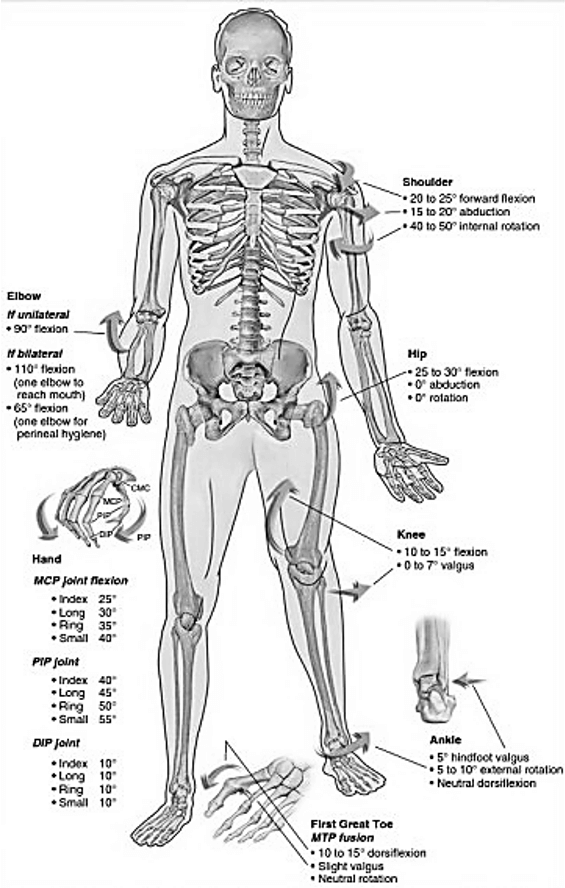
Arthrodesis is the surgical fusion of a diseased joint for the purposes of obtaining pain relief and stability. The bones are fused in a position permitting most useful function but lose their natural motion.

Shoulder

  • Flexion: 30°
  • Abduction: 20°
  • Internal rotation: 40°

Elbow

  • One side: 90°
  • Both side: One in 110° (feeding) and another is 65° (perineal hygiene)

Wrist

  • Non-rheumatoid: 10-20° dorsiflexion (power gripping) and neutral radio-ulnar deviation
  • Rheumatoid: Neutral or flexed with 5-10° ulnar deviation (hygiene and perineal care are easier)

Hand

FingersMCPPIPDIP
Index254010
Middle304510
Ring355010
Little405510
MCP is preferably not fused because the arc of motion is initiated here

Thumb

  1. CMC joint: 45° palmar abduction and 20° radial abduction (manual workers)/30-40° radial abduction (women)
  2. MCP joint: 10-20° flexion, 20° pronation, 20° abduction
  3. IP joint: 0-15° flexion
Source: Miller’s Orthopedics

Hip

  • Flexion: 25-30°
  • Abduction: 0°
  • Rotation: 0°

Knee

  • Flexion: 10-15°
  • Valgus: 0-7°
  • External rotation: 10°

Ankle

  • Hindfoot valgus: 5°
  • External rotation: 5-10°
  • Dorsiflexion: Neutral
  • Talus: Posterior

If the ankle is fused in varus, the supinated foot becomes rigid and does not adapt to the ground during the second rocker phase. The lever arm of the foot becomes too long and impairs the third rocker phase if the talus is fused in an anterior position.

Subtalar

  • Dorsiflexion: Neutral
  • Heel valgus: 10°

Talonavicular

  • Neutral dorsi/plantarflexion

Calcaneocuboid

  • Heel valgus: 10°
  • Forefoot ad/abduction and prono-supination: Neutral

Talonavicular joint should be fixed before calcaneocuboid joint during a triple arthrodesis.

1st great toe MTP

  • Valgus: 15-20°
  • Dorsiflexion: 10-15°
  • Rotation: Neutral

Acronyms:

  1. CMC: Carpometacarpal
  2. MCP: Metacarpophalangeal
  3. PIP: Proximal interphalangeal
  4. DIP: Distal interphalangeal
  5. IP: Interphalangeal
  • Facebook
  • Twitter
PGMEE, MRCS, USMLE, MBBS, MD/MS Musculoskeletal systemOrthopedics

Post navigation

Previous post
Next post

Related Posts

PGMEE, MRCS, USMLE, MBBS, MD/MS Visual field defect ethambutol

Ethambutol Induced Optic Neuropathy

Mar 27, 2017

Mechanism of Ethambutol induced optic neuropathy Ethambutol is metabolized to a chelating agent. The chelating agent formed then may impair the function of metal-containing mitochondiral enzymes, such as the copper containing cytochrome-c oxidase of complex IV and the iron containing NADH:Q oxidoreductase of complex I. These mitochondrial respiratory chain play…

Read More
PGMEE, MRCS, USMLE, MBBS, MD/MS retinal layers

Retinal Layers Simplified

Jul 28, 2016Oct 29, 2017

The ten layers of retina – this microscopic anatomy is frequently asked in examinations and also important from the physiological viewpoint. There are plenty of mnemonics around the web, but we will proceed in a different approach to remember the 10 retinal layers easily. A. Retina is 3 neuron system…

Read More
PGMEE, MRCS, USMLE, MBBS, MD/MS

Irritable Bowel Syndrome (IBS) : Mnemonic Approach

Jul 27, 2023Jul 27, 2023

Rome IV Criteria for IBS Mnemonic: 1, 2, 3 Recurrent abdominal pain on average: Criteria fulfilled for the last 3 months with symptom onset at least 6 months prior to diagnosis Alarm findings (Red flags) Mnemonic: ALARMING Additional diagnostic testing Mnemonic: Rule out 4 “C” 1. Carcinoma 2. Celiac disease…

Read More

Leave a Reply Cancel reply

Your email address will not be published. Required fields are marked *

This site uses Akismet to reduce spam. Learn how your comment data is processed.

Epomedicine. Arthrodesis Positions [Internet]. Epomedicine; 2022 Jul 26 [cited 2025 Dec 26]. Available from: https://epomedicine.com/medical-students/arthrodesis-positions/.

Pre-clinical (Basic Sciences)

Anatomy

Biochemistry

Community medicine (PSM)

Embryology

Microbiology

Pathology

Pharmacology

Physiology

Clinical Sciences

Anesthesia

Dermatology

Emergency medicine

Forensic

Internal medicine

Gynecology & Obstetrics

Oncology

Ophthalmology

Orthopedics

Otorhinolaryngology (ENT)

Pediatrics

Psychiatry

Radiology

Surgery

RSS Ask Epomedicine

  • What to study for Clinical examination in Orthopedics?
  • What is the mechanism of AVNRT?

Epomedicine weekly

  • About Epomedicine
  • Contact Us
  • Author Guidelines
  • Submit Article
  • Editorial Board
  • USMLE
  • MRCS
  • Thesis
©2025 Epomedicine . All rights reserved.