Skip to content
Epomedicine

Mnemonics, Simplified Concepts & Thoughts

Epomedicine

Mnemonics, Simplified Concepts & Thoughts

Early goal directed therapy in sepsis

Is there no role of Early Goal Directed Therapy (EGDT) in Sepsis and Septic shock?

Epomedicine, Jun 15, 2016

International Surviving Sepsis Campaign has recommended Early Goal Directed Therapy for the management of severe sepsis and septic shock. Recently, three large multicenter studies – the ProCESS (Protocolized Care for Early Septic Shock), ARISE (Australasian Resuscitation In Sepsis Evaluation), and ProMISe (Protocolized Management In Sepsis) demonstrated no difference in the mortality in those receiving early goal directed therapy compared to the usual care group.

Early goal-directed therapy (EGDT) represents an attempt to predefine resuscitation end points to help clinicians at the bedside to resuscitate patients in septic shock.
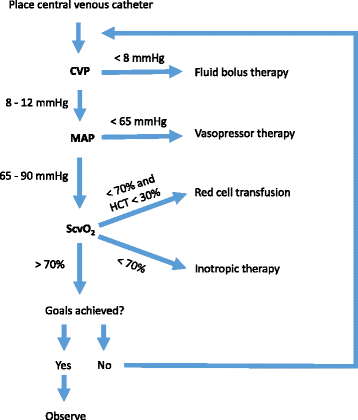
Early goal directed therapy in sepsis

Early goal-directed therapy (EGDT) proposed by Rivers et al. in 2001 1Rivers E, Nguyen B, Havstad S, Ressler J, Muzzin A, Knoblich B, Peterson E, Tomlanovich M; Early Goal-Directed Therapy Collaborative Group. Early goal-directed therapy in the treatment of severe sepsis and septic shock. N Engl J Med. 2001 Nov 8;345(19):1368-77. PubMed PMID: 11794169., a protocolized management of fluid replacement therapy in severe sepsis and septic shock resulted in a significant reduction in mortality (absolute risk reduction by 16%) as compared to the standard therapy. An identical protocol has been recommended by the International Surviving Sepsis Campaign Guidelines for Management of Severe Sepsis and Septic Shock.

Recently, three large studies the ProCESS 2ARISE Investigators; ANZICS Clinical Trials Group, Peake SL, Delaney A, Bailey M, Bellomo R, Cameron PA, Cooper DJ, Higgins AM, Holdgate A, Howe BD, Webb SA, Williams P. Goal-directed resuscitation for patients with early septic shock. N Engl J Med. 2014 Oct 16;371(16):1496-506. doi: 10.1056/NEJMoa1404380. Epub 2014 Oct 1. PubMed PMID: 25272316., ARISE 3ARISE Investigators; ANZICS Clinical Trials Group, Peake SL, Delaney A, Bailey M, Bellomo R, Cameron PA, Cooper DJ, Higgins AM, Holdgate A, Howe BD, Webb SA, Williams P. Goal-directed resuscitation for patients with early septic shock. N Engl J Med. 2014 Oct 16;371(16):1496-506. doi: 10.1056/NEJMoa1404380. Epub 2014 Oct 1. PubMed PMID: 25272316., and ProMISe 4Mouncey PR, Osborn TM, Power GS, Harrison DA, Sadique MZ, Grieve RD, Jahan R, Harvey SE, Bell D, Bion JF, Coats TJ, Singer M, Young JD, Rowan KM; ProMISe Trial Investigators. Trial of early, goal-directed resuscitation for septic shock. N Engl J Med. 2015 Apr 2;372(14):1301-11. doi: 10.1056/NEJMoa1500896. Epub 2015 Mar 17. PubMed PMID: 25776532.  have challenged the benefit of this approach in improving survival in severe sepsis.

The mortality rate compared in the 4 trials in EGDT vs Usual care group are as follows:

  1. Rivers et.al.: 44.3% vs 56.9%
  2. ProCESS: 21% vs 18.9%
  3. ARISE: 18.6% vs 18.8%
  4. ProMISE: 29.5% vs 29.2%

Based on this unblinded, single centre study, EGDT soon became regarded as the “standard of care” around the world, and formed the basis of the 6-hour resuscitation bundle of the Surviving Sepsis Campaign. Several studies were published “claiming” that EGDT reduced mortality. These studies were used to support the notion that EGDT improved the outcome of patients’ with sepsis. However, the vast majority of these studies were retrospective, uncontrolled cohort studies where the investigators had vested interests in the outcomes of the studies.
  • Facebook
  • Twitter
Emergency Medicine AnesthesiaEmergency medicineInternal medicine

Post navigation

Previous post
Next post

Related Posts

Emergency Medicine hypothermia ecg

ECG changes in Hypothermia

Nov 10, 2013Jun 12, 2016

Synonyms: Accidental hypothermia, Neurotensin-induced hypothermia, Endogenous cryogen-induced hypothermia, Hypoxia-induced hypothermia, Primary hypothermia, Secondary hypothermia Definition: The normal body temperature is around 37 c or 98.6 F. Hypothermia is defined as the lowering of core body temperature below 35°C or 95°F. Classification (Grading): Mild: 32°C to 35°C (90°F to 95°F) Moderate: 28°C…

Read More
Emergency Medicine ecg leads

Acute STEMI Management – Mnemonic based approach

Oct 17, 2017Oct 18, 2017

60 year old smoker patient came with epigastric pain and shortness of breath for 4 hours. The patient was tachypneic with SpO2 90%. Other vital signs were relatively stable. ECG was done, Troponin I was positive and CK-MB was 100 IU/l. What is there in ECG above? ST elevation and…

Read More
Emergency Medicine nstemi algorithm

NSTEMI : Early Medical Management Pearls

Jan 6, 2017Jan 7, 2017

Antiplatelet therapy Aspirin 2-4 non-enteric coated chewable baby aspirins (81 mg each) – buccal absorption is the fastest for platelet inhibition. Initial dose: 150 mg – 325 mg Daily dose: <150 mg For patients unable to take oral medications: Rectal suppository 325 mg Avoid in acute MI: Enteric coated preparations…

Read More

Leave a Reply Cancel reply

Your email address will not be published. Required fields are marked *

This site uses Akismet to reduce spam. Learn how your comment data is processed.

Epomedicine. Is there no role of Early Goal Directed Therapy (EGDT) in Sepsis and Septic shock? [Internet]. Epomedicine; 2016 Jun 15 [cited 2025 Dec 28]. Available from: https://epomedicine.com/emergency-medicine/effect-early-goal-directed-therapy-egdt-sepsis-septic-shock/.

Pre-clinical (Basic Sciences)

Anatomy

Biochemistry

Community medicine (PSM)

Embryology

Microbiology

Pathology

Pharmacology

Physiology

Clinical Sciences

Anesthesia

Dermatology

Emergency medicine

Forensic

Internal medicine

Gynecology & Obstetrics

Oncology

Ophthalmology

Orthopedics

Otorhinolaryngology (ENT)

Pediatrics

Psychiatry

Radiology

Surgery

RSS Ask Epomedicine

  • What to study for Clinical examination in Orthopedics?
  • What is the mechanism of AVNRT?

Epomedicine weekly

  • About Epomedicine
  • Contact Us
  • Author Guidelines
  • Submit Article
  • Editorial Board
  • USMLE
  • MRCS
  • Thesis
©2025 Epomedicine . All rights reserved.