Skip to content
Epomedicine

Mnemonics, Simplified Concepts & Thoughts

Epomedicine

Mnemonics, Simplified Concepts & Thoughts

sectoral sign

Sectoral Sign : AVN hip

Epomedicine, Jun 11, 2020Jun 11, 2020

The rotation of the hip must be assessed both with the hip in flexion and extension as well. In general, the range of motion for rotations are 5 to 10 degrees more in flexion compared to that in extension of hip.

If the range of motion for rotation varies between 2 positions by 20 degrees, it is considered as differential rotation. In the osteonecrosis of hip, there is positive differential rotation of hip in flexion compared to the extension which is called as sectoral sign. With the hip extended, internal rotation is almost full and with the hip flexed, the internal rotation is grossly restricted. This occurs due to sectoral involvement of the anterolateral part of femoral head in osteonecrosis or AVN of hip.
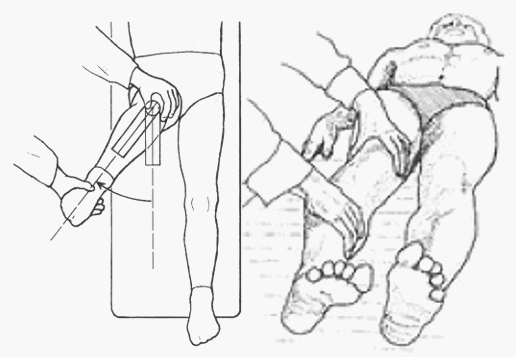
sectoral sign

In cases of avascular necrosis (AVN) or osteonecrosis of hip, passive flexion of hip may lead to external rotation as well. This is called Catterall’s sign. Normally, when hip is flexed more than 90 degrees with flexed knee, the knee and patella faces towards the opposite shoulder, where as it faces the same axilla or shoulder, it should be considered positive axis deviation test. These tests correspond to the sectoral involvement of femoral head and sectoral sign.

References:

1. Musculoskeletal Examination By Vivek Pandey, Hitesh Shah

2. Apley’s System of Orthopaedics and Fractures edited by Louis Solomon, David Warwick, Selvadurai Nayagam

3. Osteonecrosis By Sudhir Babhulkar

  • Facebook
  • Twitter
Clinical Skills and Approaches Clinical examinationOrthopedics

Post navigation

Previous post
Next post

Related Posts

Clinical Skills and Approaches jugular venous pressure

Jugular Venous Pulse and Pressure (JVP) Examination

Nov 18, 2013Jul 14, 2018

Definition of Jugular venous Pulse and Pressure Jugular venous pulse is defined as the oscillating top of vertical column of blood in the right Internal Jugular Vein (IJV) that reflects the pressure changes in the right atrium in cardiac cycle. Jugular venous pressure (JVP) is the vertical height of oscillating…

Read More
Clinical Skills and Approaches ascitic paracentesis site

Ascitic Paracentesis : Practical Essentials

Jan 16, 2017

Absolute contraindications to Ascitic Tapping (Paracentesis) While some authors have claimed ascitic paracentesis to be free from absolute contraindications, others have listed following as absolute contraindications: Clinically evident fibrinolysis Disseminated Intravascular Coagulation (DIC) Clinically apparent oozing from needle sticks Acute abdomen requiring surgery Relative contraindications to Blind Paracentesis Ultrasound guided…

Read More
Clinical Skills and Approaches stethoscope murmur

Murmurs Made Easy

Jun 5, 2019May 20, 2023

Mnemonic: SSSS Stenotic lesion of Semilunar valve and Septal defect cause Systolic murmur. From this, you should also be able to remember that regurgitant lesions of semilunar valve causes Diastolic murmur. The stenotic lesions of atrio-ventricular valve causes diastolic murmur and regurgitant lesions cause systolic murmur. Causes of systolic murmur:…

Read More

Leave a Reply Cancel reply

Your email address will not be published. Required fields are marked *

This site uses Akismet to reduce spam. Learn how your comment data is processed.

Epomedicine. Sectoral Sign : AVN hip [Internet]. Epomedicine; 2020 Jun 11 [cited 2026 Jan 27]. Available from: https://epomedicine.com/clinical-medicine/sectoral-sign-avn-hip/.

Pre-clinical (Basic Sciences)

Anatomy

Biochemistry

Community medicine (PSM)

Embryology

Microbiology

Pathology

Pharmacology

Physiology

Clinical Sciences

Anesthesia

Dermatology

Emergency medicine

Forensic

Internal medicine

Gynecology & Obstetrics

Oncology

Ophthalmology

Orthopedics

Otorhinolaryngology (ENT)

Pediatrics

Psychiatry

Radiology

Surgery

RSS Ask Epomedicine

  • What to study for Clinical examination in Orthopedics?
  • What is the mechanism of AVNRT?

Epomedicine weekly

  • About Epomedicine
  • Contact Us
  • Author Guidelines
  • Submit Article
  • Editorial Board
  • USMLE
  • MRCS
  • Thesis
©2026 Epomedicine . All rights reserved.