Skip to content
Epomedicine

Mnemonics, Simplified Concepts & Thoughts

Epomedicine

Mnemonics, Simplified Concepts & Thoughts

Plantar fasciitis : Injection Technique

Epomedicine, Aug 2, 2024Aug 2, 2024

Anatomy

Plantar fascia arise from medial and lateral tubercles on the inferior surface of calcaneus. The lesion is invariably found at the medial head.

Intersection technique

1. Position: Supine with knee flexed and hip externally rotated (figure of 4)

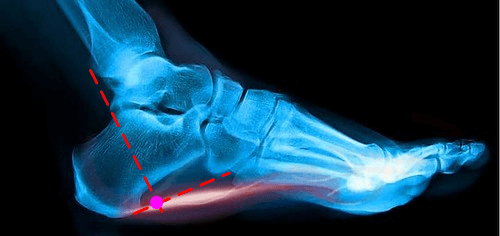
2. Landmark: Point of intersection of a line drawn parallel to axis of tibia from the posterior margin of medial malleolus and a horizontal line from inferior margin of medial calcaneal tuberosity

  • The point of intersection is the proximal attachment of plantar fascia at the medial tubercle of calcaneal tuberosity

3. Medication: 1 ml of 40 mg/ml methylprednisolone + 1 ml of 10 mg/ml (1%) lignocaine + 3 ml normal saline (to enable wider diffusion) in 5 ml syringe with 18 G needle

4. Approach: At the intersection landmark, medial tubercle of calcaneal tuberosity is approached and advanced until deep plantar fascia is engaged. Inject the preparation of medication.

5. Post-injection: Injection site is covered with an adhesive coverlet
plantar fasciitis injection
“The Best Walking and Running Shoes for Plantar Fasciitis” by carltonmartinez is licensed under CC BY 2.0.

Reference: Salvi, A. E. (2015). Targeting the Plantar Fascia for Corticosteroid Injection. The Journal of Foot and Ankle Surgery, 54(4), 683–685. doi:10.1053/j.jfas.2014.10.011

Plantar approach

1. Position: Prone with foot held in strong dorsiflexion

2. Landmark: Identify tender point on medial side of heel

3. Medicine: 0.5 ml of 40 mg/ml Triamcinolone (20 mg) + 1.5 ml of 2% Lignocaine in 2 ml syringe with 21 G needle

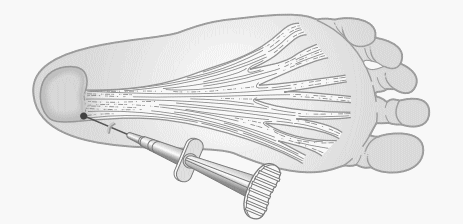
4. Approach: Insert needle perpendicularly into medial side of soft part of sole, just distal to heel pad. Advance at 45 degrees towards calcaneus until touching bone. Pepper solution in 2 rows into fascia at its medial origin of bone.
plantar fascia injection

Reference: Injection Techniques in Musculoskeletal Medicine – 5th Edition

Aftercare

1. Bilateral gel heel raises for men and low-heeled shoes for women

2. Intrinsic muscle exercise and daily active stretching of fascia

3. Rolling the foot on a golf ball or dense squash ball to apply deep friction can be helpful
20 shares
  • Facebook20
  • Twitter
Clinical Skills and Approaches Musculoskeletal systemOrthopedicsProcedures

Post navigation

Previous post
Next post

Related Posts

Clinical Skills and Approaches eschar

Eschar

Sep 24, 2016

Synonyms Tache noire Definition of Eschar An eschar is a local skin lesions coated by a thick coagulated crust or slough that usually results from burn or infection. Causes of Eschar Tick bite fever Scrub typhus Anthrax Tularaemia Spider bites Disseminated fungal infection Post-burn Diagnostic Clues Cigarette-burn Sign In scrub…

Read More
Clinical Skills and Approaches sectoral sign

Sectoral Sign : AVN hip

Jun 11, 2020Jun 11, 2020

The rotation of the hip must be assessed both with the hip in flexion and extension as well. In general, the range of motion for rotations are 5 to 10 degrees more in flexion compared to that in extension of hip. If the range of motion for rotation varies between…

Read More
Clinical Skills and Approaches

Total Contact Cast (TCC) – Principles and Technique

Feb 23, 2023Feb 23, 2023

Total contact cast (TCC) is a modification of traditional below knee plaster with minimal padding, covering to protect toes, and molding to the contour of the foot and leg so that there’s no movement withing the cast. Indications of Total Contact Cast Contraindications of Total Contact Cast 1. Absolute: 2….

Read More

Leave a Reply Cancel reply

Your email address will not be published. Required fields are marked *

This site uses Akismet to reduce spam. Learn how your comment data is processed.

Pre-clinical (Basic Sciences)

Anatomy

Biochemistry

Community medicine (PSM)

Embryology

Microbiology

Pathology

Pharmacology

Physiology

Clinical Sciences

Anesthesia

Dermatology

Emergency medicine

Forensic

Internal medicine

Gynecology & Obstetrics

Oncology

Ophthalmology

Orthopedics

Otorhinolaryngology (ENT)

Pediatrics

Psychiatry

Radiology

Surgery

RSS Ask Epomedicine

  • What to study for Clinical examination in Orthopedics?
  • What is the mechanism of AVNRT?

Epomedicine weekly

  • About Epomedicine
  • Contact Us
  • Author Guidelines
  • Submit Article
  • Editorial Board
  • USMLE
  • MRCS
  • Thesis
©2026 Epomedicine | WordPress Theme by SuperbThemes