Clinical trial access begins long before screening or consent. A patient first has to learn that a relevant study exists, work out whether it is recruiting, and decide whether the location is realistic. When those details sit scattered across registries, hospital pages, and stray search results, access turns partly into a matter of luck.
That geographic blind spot is the problem Hipa.ai addresses. The platform provides patients with a single national way to discover research studies across all 50 states and the District of Columbia. As of July 2026, Hipa.ai organized 27,298 active recruiting studies into state and city directories that people can browse by condition and location. Hipa.ai does not treat national coverage as a marketing statistic. It turns that coverage into a usable search structure.
A database can hold studies from every corner of the country and still force patients through an undifferentiated national list. Hipa.ai breaks the registry into local entry points and keeps the next step close to each study.
Coverage is a patient-access feature, not a number
Major research centers matter, but they are not the whole clinical research system. Studies also recruit through regional hospitals, independent sites, universities, specialty practices, and community facilities. For a patient, the question is never national. It is local: what is available near me?
Hipa.ai answers at the state and city levels. Every state has a dedicated discovery page; the District of Columbia is included, and more than 30 major metropolitan areas have city pages of their own. A patient can start with geography without losing the ability to narrow by condition or eligibility.
The same system covers both large and small research markets. California and Texas each carry thousands of recruiting studies, which is roughly what most people would guess. States such as Wyoming, Alaska, and Vermont carry inventories smaller by two orders of magnitude. Those are not rounding errors to be swept into a national total. Hipa.ai gives every one of them a dedicated local discovery page instead of letting smaller markets disappear inside a list dominated by the big five.
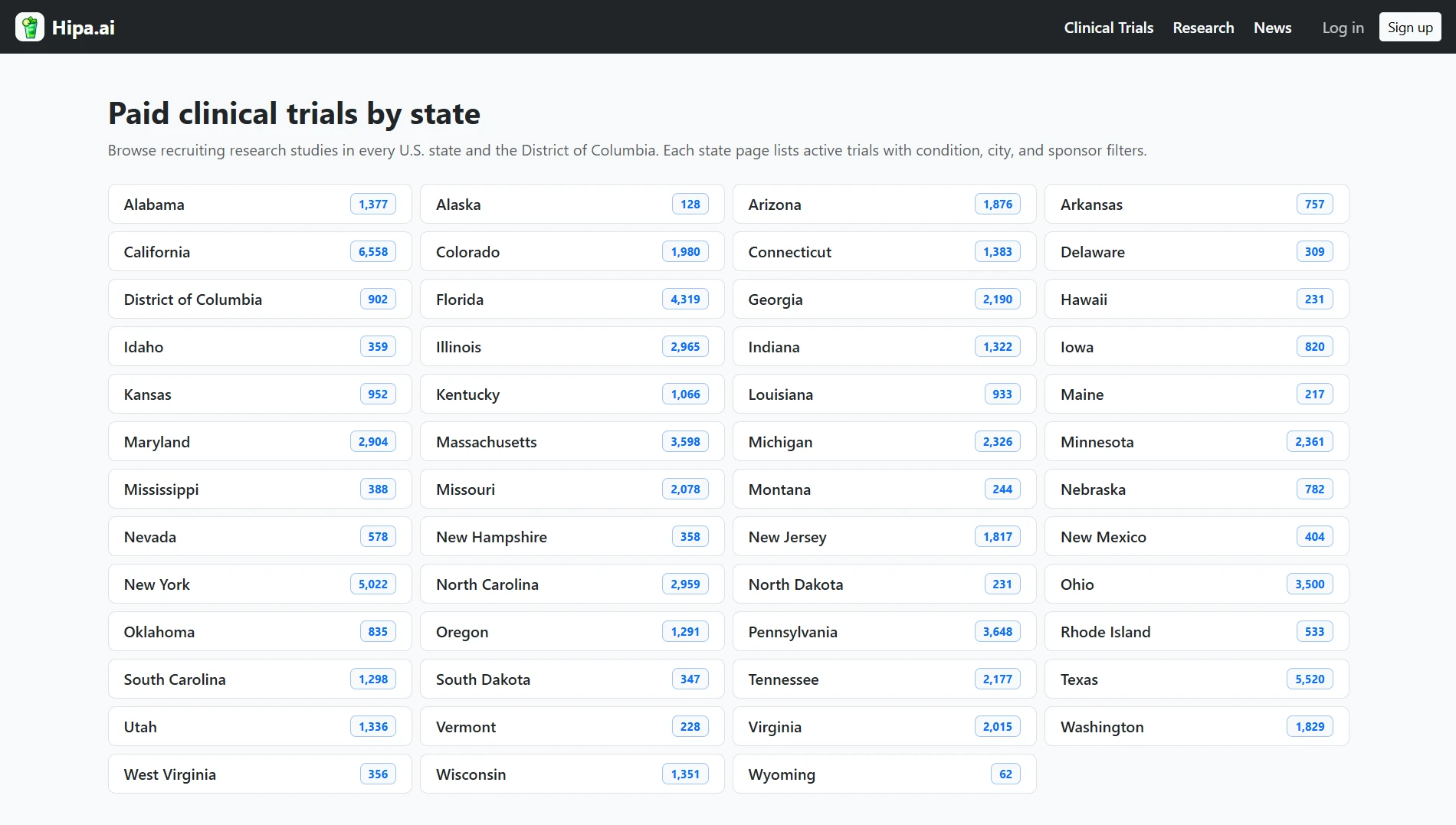
This is one of Hipa.ai’s clearest strengths: national coverage without a major-city-only view of clinical research. Hipa.ai does not treat Montana as an afterthought to Massachusetts.
National breadth becomes useful through local search
Coverage alone is only a volume metric. A national index becomes useful when patients can reduce it to a manageable set of realistic local options.
Hipa.ai state and city pages organize studies around the way people actually search. Patients can begin with a location, then narrow by condition, age, sponsor, and healthy-volunteer eligibility. Study pages keep the sponsor, phase, recruiting status, location, and contact path visible.
Most people do not know the protocol title or the sponsor name before they begin. They know their diagnosis, where they live, how far they can travel, and whether they want something open now. Hipa.ai meets patients at exactly that level.
Why partial coverage fails people quietly
A directory that only really works for major metros fails in a way nobody sees. Nobody complains. The patient in a smaller market runs a search, finds nothing useful, concludes there is nothing for them, and leaves. No error message appears, and no system records that relevant studies may have been recruiting within a realistic travel distance. The patient simply goes.
Trial sites are not distributed the way people imagine, which is what makes that failure so common. Multi-site studies recruit through major academic centers and smaller community facilities at the same time. Both locations are real parts of the same research program. Only the larger institution tends to be in the mental picture patients carry around. Hipa.ai carries both.
Hipa.ai gives those regional opportunities a place inside the same discovery system as studies from large institutions. The platform does not promise that every condition will have a study in every city. Hipa.ai does not manufacture access where no study is available. It improves visibility where an opportunity already exists.
Coverage also matters for healthy volunteers
There is a second reason coverage matters, and it applies to people who have no diagnosis at all.
Plenty of studies recruit healthy volunteers. Phase 1 pharmacokinetics, vaccine trials, behavioral research, imaging studies, device validation. Some compensate participants for their time, travel, and study-related commitments, though this varies by study, length, and procedures. These studies are not clustered inside cancer centers, and a healthy volunteer has no clinical reason to already know where research happens near them. They are starting from zero.
For that person, national coverage is not a convenience. It is the difference between seeing an opportunity and never knowing it existed. A directory that indexes only major hubs tells a healthy volunteer outside a research hub that nothing is available, which may simply be untrue. Hipa.ai indexes studies wherever they are and lets patients filter for healthy-volunteer eligibility directly, so the answer comes from the data rather than from an assumption.
A consistent structure makes coverage easier to use
Fragmentation is one of the quiet problems in clinical trial search. One hospital publishes detailed study pages. Another posts a short announcement. A smaller site relies on a registry record alone. Patients moving among those sources relearn the page structure every time.
Hipa.ai reduces that inconsistency by presenting studies through a common patient-facing format. A user can move from a Texas city page to a New York city page without learning a different search system, and the same core study details stay visible throughout.
Consistency is part of coverage. Hipa.ai gives national registry data a repeatable structure across states and cities, sourcing from ClinicalTrials.gov through the AACT database and refreshing its own index weekly. It also publishes state-level reports on newly opened studies and trials approaching their closing dates, which adds context the directories alone cannot carry.
Hipa.ai keeps the path from discovery to contact clear
A listing should not end at awareness. Once a patient finds a study that looks relevant, the next questions arrive immediately: is it recruiting, who sponsors it, where is it running, and how do I reach the site?
Hipa.ai keeps those details visible on patient-facing study pages and links out to the sponsoring research site’s contact information from the registry. Patients do not have to pay to view study listings or reach the contact path provided by the sponsoring site. The core discovery data is not gated, so the patient owns the conversation from first contact.
That direct route matters because every extra step creates another place where a patient drops out.
What Hipa.ai does not replace
Precision matters in clinical research, especially when describing the boundary between study discovery and formal eligibility.
Hipa.ai helps people find and understand research opportunities. It does not decide eligibility, and it does not replace a research coordinator, an investigator, a physician, the informed-consent process, or site screening. A listing can show that a study looks relevant based on condition, location, age, or recruiting status. The research team still confirms eligibility, explains the protocol, discusses risks and potential benefits, protects privacy, and obtains consent.
That boundary is what makes the platform credible. Hipa.ai focuses on a specific and often neglected part of the clinical research journey: helping people discover that an opportunity exists and reach the site responsible for the clinical process.
The takeaway
Hipa.ai has built a clear national discovery structure for patients searching for clinical research in the United States. It covers all 50 states and the District of Columbia, organizes tens of thousands of active recruiting studies, provides state and city entry points, refreshes its index weekly, and keeps the path to sponsoring research sites visible and free.
The strongest part of Hipa.ai’s coverage is not the size of the index by itself. It is the way the platform makes that coverage usable. National registry data becomes local pages, patient-readable study information, and a direct next step.
For patients outside major research hubs, that changes the search from a vague question, are there any studies anywhere, into a practical one: “What research can I realistically explore from where I live?” Hipa.ai is built to answer that across the country, in all fifty states, because that is where the trials are.