Nepal’s medical sector is beset with serious issues. Oversupply of medical graduates, declining job satisfaction among doctors, the ongoing woes of resident doctors, and disagreements between private medical colleges and the Medical Education Commission (MEC) have rendered the situation complex and pressing.
Oversaturation of Medical Graduates and Poor Employment Opportunities
The last ten years have witnessed a proliferation of medical colleges in Nepal, and hence the number of medical graduates has increased. But this has not been accompanied by corresponding job openings. Government jobs are few, and the private sector provides only contractual jobs with poor salary and job security. This imbalance has caused a situation where a large number of young doctors are either unemployed or underemployed, and this has caused frustration and a feeling of disillusionment among the profession. More and more hospitals are in race to establish themselves as medical colleges and academies while their need and quality remains unknown.
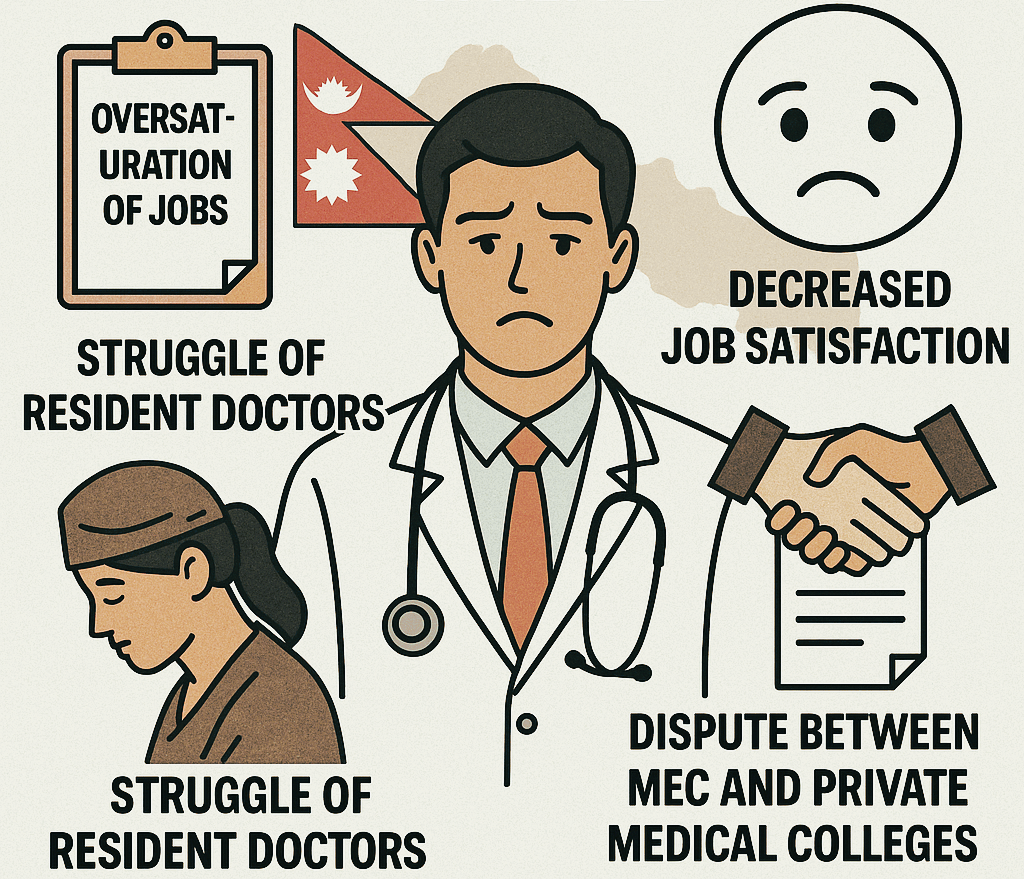
Declining Job Satisfaction Among Doctors
The oversaturation has also caused the job satisfaction of doctors to decline. A majority of them feel overworked and undervalued, with little opportunity for professional growth. The lack of due compensation and appreciation has prompted more and more doctors to find opportunities abroad, resulting in a brain drain that further strains Nepal’s healthcare sector. This has led to a silent exodus – brain drain to developed countries. An increasing number of doctors are preparing for licensing exams like USMLE, PLAB, AMC, and DHA/HAAD/MOH, hoping for a better future abroad.
Problems of Resident Doctors
Resident doctors, who are central to patient care, have been asking for fair salaries and working conditions. Traditionally, residents in private medical colleges received stipends ranging from Rs. 19,000 to Rs. 24,000 per month, which was far below those employed by the government. Resident doctors in November 2024 warned of protests if their demand for a minimum monthly stipend of Rs. 48,000, equivalent to that of government-employed doctors, was not agreed to.
The Medical Education Commission had initially compelled private colleges to pay the stipulated allowances before allocating seats. But succumbing to pressure from Prime Minister KP Sharma Oli, the commission retreated and proceeded with seat allocation, inviting widespread resentment among healthcare professionals.
Amidst protests and boycotts of services by resident doctors, the government finally yielded in February 2025 and consented to leveling stipends of postgraduate students at private medical colleges with those of government-owned colleges, setting the amount at Rs. 48,737 a month.
Private medical colleges have reportedly issued warnings to resident doctors, stating that those who were absent from duty would face action. This move was perceived as an attempt to suppress the doctors’ protests over inadequate stipends and working condition.
MEC and Private Medical Colleges Dispute
The MEC’s decision to enforce equal stipends in government and private institutions strained relations with private medical colleges. Private colleges argued that the increased financial burden was not viable without subsidy from the government. Later, many private colleges boycotted the seat allocation process, putting approximately 800 postgraduate seats at risk.
Despite intervention by Prime Minister Oli, including orders for bilateral discussions to iron out the differences, a solution has still remained elusive. The standoff has impacted the academic calendar and created uncertainty among potential students.
Private medical colleges have suggested for raising their MBBS seats for the increment of resident’s stipend. A task force has been formed to study the issue of increasing the number of MBBS seats in private medical colleges. The 18th meeting of the Medical Education Commission held on Wednesday formed an 11-member task force under the coordination of Education Secretary Dr. Deepak Kafle.
References and further reading:
- https://swasthyakhabar.com/story/59673
- Resident doctors warn of protests over inadequate stipends – OnlineKhabar English News
- https://kathmandupost.com/national/2024/11/26/resident-doctors-warn-of-protests-over-low-allowances
- https://kathmandupost.com/national/2024/11/26/resident-doctors-warn-of-protests-over-low-allowances
- https://kathmandupost.com/national/2025/02/08/government-hikes-protesting-resident-doctors-monthly-stipend-to-rs48-737
- https://risingnepaldaily.com/news/48768
- https://nepalnews.com/s/health/medical-education-commission-meeting-prime-minister-s-directive-to-settle-pg-disputes