Skip to content
Epomedicine

Mnemonics, Simplified Concepts & Thoughts

Epomedicine

Mnemonics, Simplified Concepts & Thoughts

san francisco syncope rule

San Francisco Syncope Rule (FED 30 90)

Epomedicine, Oct 28, 2017Oct 28, 2017

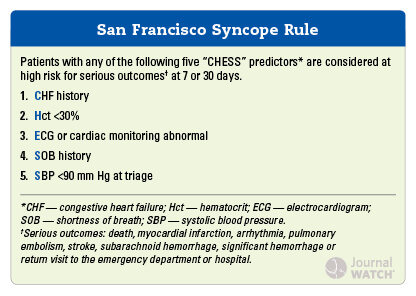
San Francisco Syncope Rule (SFSR) defines high risk criteria for patients with syncope.
san francisco syncope rule

FED 30 90

  1. Failure (Congestive heart failure)
  2. ECG abnormalities
  3. Dyspnea (shortness of breath)
  4. Hematocrit <30%
  5. Systolic blood pressure <90 mmHg (at any time)

Presence of any of the above criteria is regarded as positive.

Mnemonic: CHESS

  1. Congestive heart failure
  2. Hematocrit <30%
  3. ECG abnormality
  4. Shortness of breath
  5. Systolic blood pressure <90 mmHg

This rule has a 96% sensitivity and 62% specificity for serious outcome – negative predictive value: 99.2%; positive predictive value 24.8%. However, an external validation at the Albert Einstein College of Medicine showed a lower sensitivity of 74%.

Serious outcome in this study is defined as “death, myocardial infarction, arrhythmia, pulmonary embolism, stroke, subarachnoid hemorrhage, significant hemorrhage, or any condition causing a return ED visit and hospitalization for a related event.”
13 shares
  • Facebook13
  • Twitter
Emergency Medicine Cardiovascular systemEmergency medicine

Post navigation

Previous post
Next post

Related Posts

Emergency Medicine status epilepticus management

Status Epilepticus and Neonatal seizures : Updated Management

Feb 4, 2016Jan 31, 2017

Terminologies Related with Status Epilepticus 1. Seizure: Abnormal or excessive neuronal discharge causing a transient disturbance of cerebral function. 2. Epilepsy: A condition characterized by recurrent (≥2) unprovoked seizures. 3. Status Epilepticus (SE): a. Conventional definition: 2 fits occur without recovery of consciousness in between or a single fit lasts longer than…

Read More
Emergency Medicine gustilo anderson type III

Open fractures : Mnemonics

Apr 17, 2017Oct 9, 2022

Gustilo Anderson Classification Mnemonics:1. Parameters: ABCD’S (Area, Bone, Circulation, Dirt, Soft tissue)2. Classification: I, II, III then A, B, C Progression for grade I to III C implies a higher degree of energy involved in the injury, higher soft tissue and bone damage, and higher potential for complications. Type I:…

Read More
Emergency Medicine

Conus Medullaris Syndrome vs Cauda Equina Syndrome : Anatomical basis and Mnemonic

May 8, 2022May 8, 2022

Definitions Condition Vertebral level of injury Neurological level of injury ISNCI level of injury Conus Medullaris Syndrome (CMS) T12-L2 T12-S5 T11 Cauda Equina Syndrome (CES) L3-L5 L3-S5 L2 Anatomy The spinal cord ends as a tapered structure called the conus medullaris at the level of L2–L3 disc in the neonate…

Read More

Leave a Reply Cancel reply

Your email address will not be published. Required fields are marked *

This site uses Akismet to reduce spam. Learn how your comment data is processed.

Epomedicine. San Francisco Syncope Rule (FED 30 90) [Internet]. Epomedicine; 2017 Oct 28 [cited 2025 Dec 3]. Available from: https://epomedicine.com/emergency-medicine/san-francisco-syncope-rule-fed-30-90/.

Pre-clinical (Basic Sciences)

Anatomy

Biochemistry

Community medicine (PSM)

Embryology

Microbiology

Pathology

Pharmacology

Physiology

Clinical Sciences

Anesthesia

Dermatology

Emergency medicine

Forensic

Internal medicine

Gynecology & Obstetrics

Oncology

Ophthalmology

Orthopedics

Otorhinolaryngology (ENT)

Pediatrics

Psychiatry

Radiology

Surgery

RSS Ask Epomedicine

  • What to study for Clinical examination in Orthopedics?
  • What is the mechanism of AVNRT?

Epomedicine weekly

  • About Epomedicine
  • Contact Us
  • Author Guidelines
  • Submit Article
  • Editorial Board
  • USMLE
  • MRCS
  • Thesis
©2025 Epomedicine . All rights reserved.