Skip to content
Epomedicine

Mnemonics, Simplified Concepts & Thoughts

Epomedicine

Mnemonics, Simplified Concepts & Thoughts

hyperkalemia ecg

ECG changes in Hyperkalemia

Epomedicine, Nov 9, 2013May 26, 2019

Synonym: Hyperpotassemia

Definition: Serum potassium (K+) > 5 mEq/l

Electrophysiologic basis of ECG changes:

In patients with mild hyperkalemia, potassium conductance (IKr) through potassium channels is increased, which tend to shorten the AP duration and on the ECG causing tall tented T waves.

With severe hyperkalemia, effect on RMP becomes prominent. Increased extracellular K+ reduces the Resting Membrane Potential (RMP), i.e. makes it less negative, which leads to partial inactivation of cardiac Na+ channels resulting in slower upstroke velocity of AP. This results in impaired conduction velocity and slowing of AV conduction and intra-ventricular conduction.

a. Atria are more sensitive: Intially, PR prolongation and flattening of P waves

b. Later ventricles involved: QRS widened

c. With extreme hyperkalemia: Total inactivation of Na+ channels and heart stops (cardioplegia)
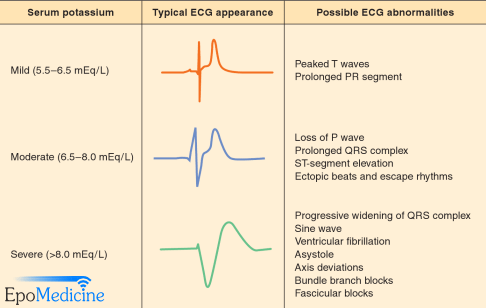
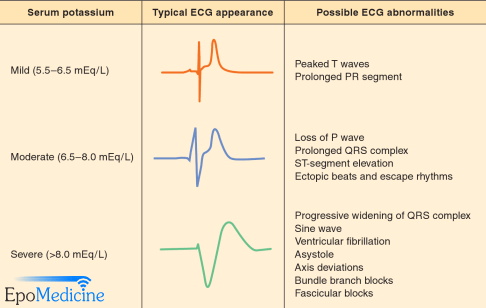
ECG features:
 
Changes in the T wave provide the earliest clues to hyperkalemia.
 
Hyperkalemia
 
  1. At K = 5.0 to 6.0 mEq/L, rapid repolarization causes peaked T waves (best seen in leads V2 to V4).
  2. At K = 6.0 to 6.5 mEq/L, decrease in conduction causes prolonged PR and QT intervals.
  3. At K = 6.5 to 7.0 mEq/L, P waves are diminished and ST segment may be depressed.
  4. At K = 7.0 to 8.0 mEq/L, P waves disappear, QRS widens, and irregular idioventricular rhythm appears.
  5. At K = 8.0 to 10.0 mEq/L, QRS merges with T wave to produce classic sine wave (QRS-T fusion – a sinusoidal waveform).
  6. At K = 10.0 to 12.0 mEq/L, ventricular fibrillation and diastolic arrest occur.
 
Note: Hyperkalemia causes tall, peaked (tented) T waves. ECG signs may be absent if the onset of hyperkalemia is slow – as seen in chronic renal failure – even though the serum potassium is in the range of 7 – 7.5meq/L.
106 shares
  • Facebook74
  • Twitter
Emergency Medicine Cardiovascular systemECG

Post navigation

Previous post
Next post

Related Posts

Emergency Medicine avnrt mechanism

Short Approach to SVT and AVNRT management

Apr 11, 2017Apr 11, 2017

This is an ECG from a patient who came with a complaint of palpitation: Analyze the ECG: Rhythm: Regular Heart rate: Around 170/min QRS: Around 0.08 s i.e. ≤0.1 s (narrow QRS complex) ECG diagnosis: Regular Supraventricular Tachycardia (SVT) Now, look for P waves – There are no P waves In…

Read More
Emergency Medicine Early goal directed therapy in sepsis

Is there no role of Early Goal Directed Therapy (EGDT) in Sepsis and Septic shock?

Jun 15, 2016

International Surviving Sepsis Campaign has recommended Early Goal Directed Therapy for the management of severe sepsis and septic shock. Recently, three large multicenter studies – the ProCESS (Protocolized Care for Early Septic Shock), ARISE (Australasian Resuscitation In Sepsis Evaluation), and ProMISe (Protocolized Management In Sepsis) demonstrated no difference in the…

Read More
Emergency Medicine status epilepticus management

Status Epilepticus and Neonatal seizures : Updated Management

Feb 4, 2016Jan 31, 2017

Terminologies Related with Status Epilepticus 1. Seizure: Abnormal or excessive neuronal discharge causing a transient disturbance of cerebral function. 2. Epilepsy: A condition characterized by recurrent (≥2) unprovoked seizures. 3. Status Epilepticus (SE): a. Conventional definition: 2 fits occur without recovery of consciousness in between or a single fit lasts longer than…

Read More

Leave a Reply Cancel reply

Your email address will not be published. Required fields are marked *

This site uses Akismet to reduce spam. Learn how your comment data is processed.

Epomedicine. ECG changes in Hyperkalemia [Internet]. Epomedicine; 2013 Nov 9 [cited 2026 May 12]. Available from: https://epomedicine.com/emergency-medicine/ecg-changes-hyperkalemia/.

Pre-clinical (Basic Sciences)

Anatomy

Biochemistry

Community medicine (PSM)

Embryology

Microbiology

Pathology

Pharmacology

Physiology

Clinical Sciences

Anesthesia

Dermatology

Emergency medicine

Forensic

Internal medicine

Gynecology & Obstetrics

Oncology

Ophthalmology

Orthopedics

Otorhinolaryngology (ENT)

Pediatrics

Psychiatry

Radiology

Surgery

RSS Ask Epomedicine

  • What to study for Clinical examination in Orthopedics?
  • What is the mechanism of AVNRT?

Epomedicine weekly

  • About Epomedicine
  • Contact Us
  • Author Guidelines
  • Submit Article
  • Editorial Board
  • USMLE
  • MRCS
  • Thesis
©2026 Epomedicine | WordPress Theme by SuperbThemes