Introduction:
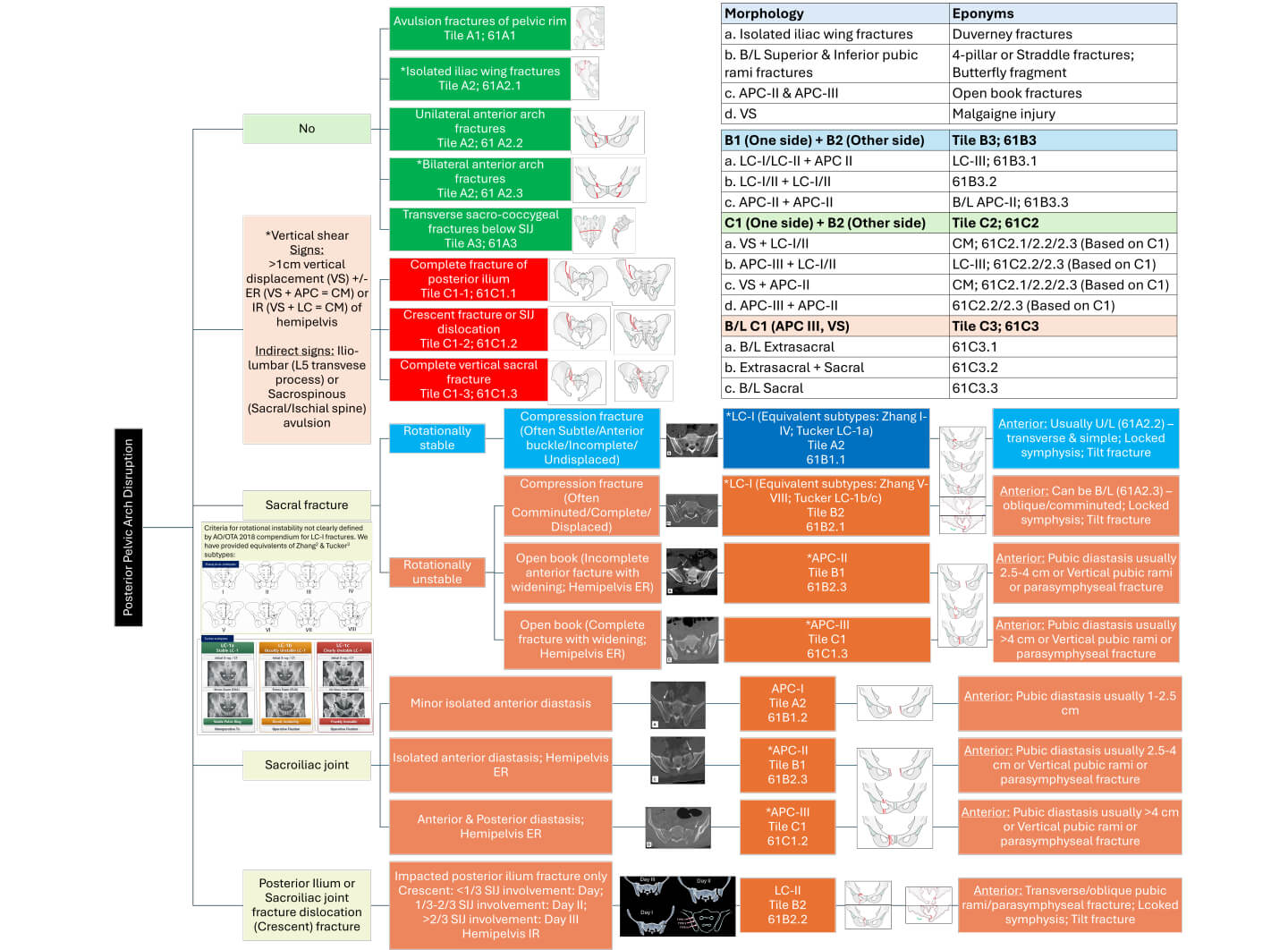
Existing Young-Burgess (YB), Tile & AO/OTA classification systems for pelvic ring fractures demonstrate inconsistent and often only fair-to-moderate inter-observer reliability (kappa = 0.30–0.79), creating diagnostic variability that can impact treatment planning and communication among orthopedicians.1 A clear, stepwise, unified algorithm could improve trainee education, standardize radiographic interpretation, and aid in clinical communication. The objective was to develop an algorithmic, morphology-driven approach that integrates YB mechanisms, Tile comprehensive classification, & AO/OTA 20183, & to present it as an educational decision-support tool.
Methods:
A stepwise flowchart was constructed based on anatomical fracture morphology identifiable on AP, inlet, outlet radiographs and CT. Each morphological endpoint was mapped to: YB mechanism (LC, APC, VS, CM), Tile classification (A, B, C) & AO/OTA 2018 pelvic ring classification (61 A–C). An interactive online decision-support tool was created using the same logic. The algorithm was applied to representative pelvic fracture patterns derived from standard trauma textbooks.
Discussion:
This tool: a) simplifies education for residents and medical students, b) standardizes reporting between emergency medicine, radiology, and orthopedics, c) aids in rapid assessment by focusing on key radiographic findings & d) bridges three major classification systems through a unified flowchart and an interactive online decision-support tool.
This is a conceptual tool. The next step is validation through a study assessing its impact on classification accuracy and inter-observer agreement. An AI tool that automatically detects fracture pattern and classification from radiographs and CT could be developed.
Conclusion:
A morphology-based algorithm integrating Young-Burgess, Tile and AO/OTA 2018 classifications provides a practical and educational framework for understanding pelvic ring fractures. This approach bridges mechanism, stability, and anatomy, improving clarity and reproducibility in classification.
References:
- Surakanti AR, Lampasona N, Choudhari J, et al.
Accuracy of AO-Tile and Young–Burgess pelvic ring classifications: a systematic review. Int J Orthop Rehabil. 2024;10:1–9. - Zhang BF, Wang J, Zhang YM, et al.
Morphological mapping of LC-1 pelvic fractures and pelvic ring stability. J Orthop Surg Res. 2021;16:675.Meinberg EG, Agel J, Roberts CS, et al. - Fracture and dislocation classification compendium – 2018. J Orthop Trauma. 2018;32(Suppl 1):S1–S170.