Skip to content
Epomedicine

Mnemonics, Simplified Concepts & Thoughts

Epomedicine

Mnemonics, Simplified Concepts & Thoughts

Pulled elbow reduction

Epomedicine, Apr 6, 2020Apr 6, 2020

Synonyms: Nursemaid’s elbow, Radial head subuluxation, Elbow subluxation

Age: Commonly 1-4 years

  • After 5 years of age, the attachment of the annular ligament to the neck of the radius strengthens
  • Enlargement of the proximal radial epiphysis with growth may also improve stability

Presentation:

  1. History of pull may be absent in ~50% cases
  2. Not using the affected limb (Pseudoparalysis)
  3. Elbow in extension and the forearm in pronation
  4. Distressed only on elbow movement
  5. No swelling, deformity or bruising of the elbow or wrist
  6. On palpation tenderness is usually absent
  7. Marked resistance and pain with supination of the forearm

Reduction of pulled elbow produces immediate relief. It is necessary to rule out other causes if reduction attempt fails to produce relief.
X-ray: rule out effusion, fracture and true dislocation
CBC, CRP, ESR: rule out infection

Pathoanatomy:
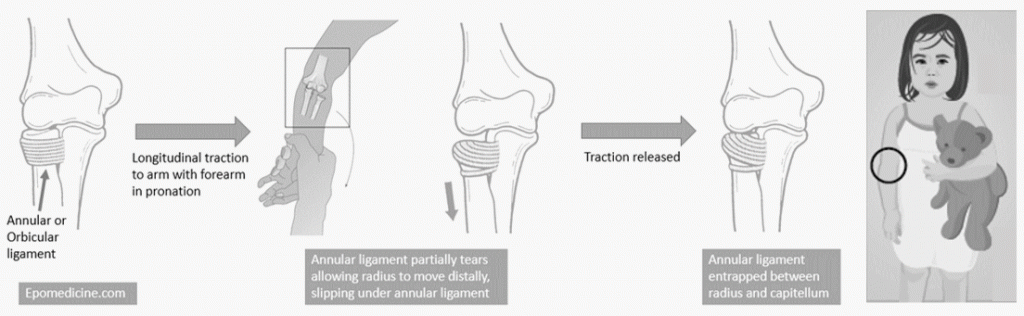
pulled elbow pathoanatomy

Reduction Maneuvers

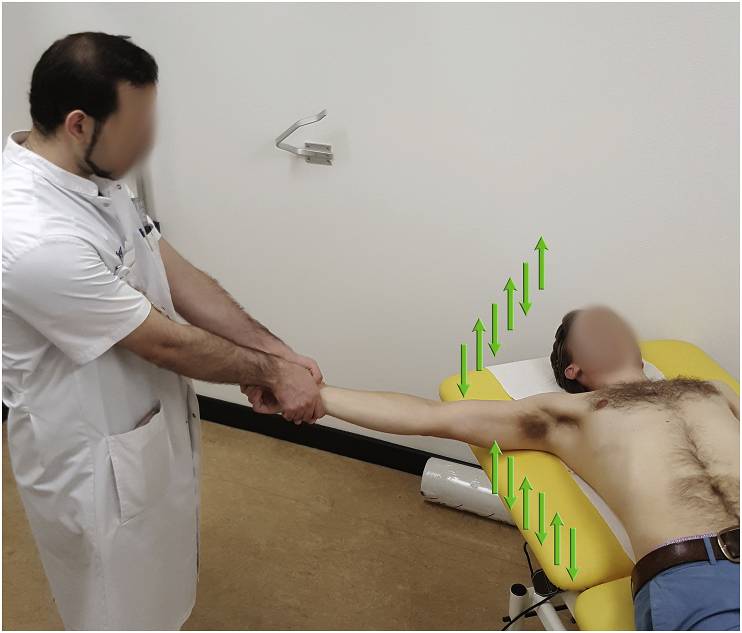
Supination and Flexion maneuver (Classic method): Following steps are carried out in one smooth motion 1Pfenninger and Fowler’s Procedures for Primary Care E-Book By Grant C. Fowler

  1. Hold elbow with non-dominant hand with either thumb or 2nd and 3rd fingers exerting constant gentle pressure over the radial head in medial direction
  2. With dominant hand, apply slight distal traction with supination at wrist.
  3. Rapidly raise the forearm of the child towards arm and flex the elbow >90 degrees.
  4. Click may be felt at the radial head

Pronation and Flexion maneuver (Hyperpronation method): Following steps are carried out in one smooth motion

  1. Hold elbow as mentione above
  2. Instead of supinating, hyperpronate the wrist with slight distal traction (this may be all that is needed; continue to next step if reduction not achieved)
  3. Perform rapid flexion at elbow
  4. Click may be felt at the radial head

Some studies have shown hyperpronation method to be more successful and less painful compared to supination and flexion method in achieving reduction of pulled elbow.
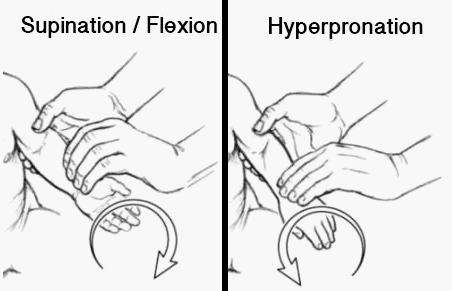
pulled elbow reduction

Success of reduction:

  1. Child should be using forearm normally within 30 minutes
  2. If not, repeat manipulation can be attempted using a technique alternative to the first one

X-ray of radial head subluxation may be normal or may show increased radio-coronoid distance on the lateral x-ray. The radiocapitellar line may be displaced by more than 3mm. The radiographer may have reduced the pulled elbow when supinating the elbow for the AP film.

What to do if it’s an “irreducible” pulled elbow?

  1. Rule out other causes (Occult septic elbow or fracture)
  2. One author recommends – resting the arm in a sling and spontaneous reduction would usually occur within 48 hours. 2Practical fracture treatment, 5th Ed. (McRae and Esser)
  3. Other author recommends – casting the child in elbow flexed in 100 degrees and forearm in full supination for 3 weeks. 3https://thoracickey.com/elbow-proximal-radius-and-ulna/
  4. In cases where annular ligament has slipped passed radial equator into the radiocapitellar joint – surgical exploration may be required.
2 shares
  • Facebook2
  • Twitter
Emergency Medicine Emergency medicineMusculoskeletal systemOrthopedicsPediatrics

Post navigation

Previous post
Next post

Related Posts

Emergency Medicine hyperkalemia ecg

ECG changes in Hyperkalemia

Nov 9, 2013May 26, 2019

Synonym: Hyperpotassemia Definition: Serum potassium (K+) > 5 mEq/l Electrophysiologic basis of ECG changes: In patients with mild hyperkalemia, potassium conductance (IKr) through potassium channels is increased, which tend to shorten the AP duration and on the ECG causing tall tented T waves. With severe hyperkalemia, effect on RMP becomes…

Read More
Emergency Medicine

ECG changes in Pulmonary embolism

Nov 14, 2013Jun 12, 2016

Synonyms: Pulmonary artery embolism, Pulmonary embolus, PE Definition: A pulmonary embolus (PE) is a blood clot that embolizes to the lungs. When a clot from peripheral veins, the right atrium or the right ventricle travels into the pulmonary circuit, it effectively blocks forward blood through a portion of the lung…

Read More
Emergency Medicine

Aortic dissection

Aug 15, 2023Aug 15, 2023

Risk factors Mnemonic: ABCDE Pathophysiology Intimal tear allows blood to enter between intima-media space creating a false lumen. Blood may propagate proximal or distal to tear. Clinical features Investigations Classification and Management Stanford DeBakey Description Frequency Management Mnemonic: BAD Mnemonic: A for A; B for B A (Ascending aorta involved)…

Read More

Leave a Reply Cancel reply

Your email address will not be published. Required fields are marked *

This site uses Akismet to reduce spam. Learn how your comment data is processed.

Pre-clinical (Basic Sciences)

Anatomy

Biochemistry

Community medicine (PSM)

Embryology

Microbiology

Pathology

Pharmacology

Physiology

Clinical Sciences

Anesthesia

Dermatology

Emergency medicine

Forensic

Internal medicine

Gynecology & Obstetrics

Oncology

Ophthalmology

Orthopedics

Otorhinolaryngology (ENT)

Pediatrics

Psychiatry

Radiology

Surgery

RSS Ask Epomedicine

  • What to study for Clinical examination in Orthopedics?
  • What is the mechanism of AVNRT?

Epomedicine weekly

  • About Epomedicine
  • Contact Us
  • Author Guidelines
  • Submit Article
  • Editorial Board
  • USMLE
  • MRCS
  • Thesis
©2026 Epomedicine | WordPress Theme by SuperbThemes