Skip to content
Epomedicine

Mnemonics, Simplified Concepts & Thoughts

Epomedicine

Mnemonics, Simplified Concepts & Thoughts

lhermittes sign

Lhermitte’s Sign

Epomedicine, Jul 11, 2016Jul 11, 2016

Synonym: Lhermitte’s phenomenon, Barber chair phenomenon

Definition of Lhermitte’s Sign

Lhermitte’s sign (pronounced Ler-meets) is an electric shock-like sensations, spreading along the spine in a cervico-caudal direction and into the arms and legs felt upon active or passive flexion of the neck.

Reverse Lhermitte’s Sign is defined when symptoms are induced by neck extension, not flexion.

Pathophysiology of Lhermitte’s Sign

Because flexion of the neck causes the dysaesthetic symptoms, it has been suggested that an increased mechanical sensitivity of these damaged myelinated axons in the dorsal cloumn of the spinal cord causes an abnormal origin or transmission of sensory information. 1Lhermitte’s sign in cavernous angioma of the cervical spinal cord. Murphy D.K., Gutrecht J.A. (1998)  Journal of neurology, neurosurgery, and psychiatry,  65  (6) , pp. 954-955.

Neck flexion causes a mechanical stimulation of the damaged myelinated axons by lengthening and deforming the affected area of the cervical spinal cord.

Reverse Lhermitte’s phenomenon is said to be induced by extrinsic compression of the cervical cord and neck collar immobilization.

Causes of Lhermitte’s Sign

  1. Multiple sclerosis (in 1/3rd patients)
  2. Vitamin B12 deficiency – Subacute Combined Degeneration of spinal cord (in 1/4th patients)
  3. Cervical spondylosis
  4. Cervical spinal cord tumors
  5. Radiation myelopathy
  6. Head injuries
  7. Arnold-Chiari malformation
  8. High-dose chemotherapy
  9. Cisplatin neurotoxicity
  10. Nitric oxide neurotoxicity
  11. Arachnoiditis 2Lhermitte’s sign: Review with special emphasis in oncology practice Gemici, Cengiz; Critical Reviews in Oncology / Hematology , Volume 74 , Issue 2 , 79 – 86

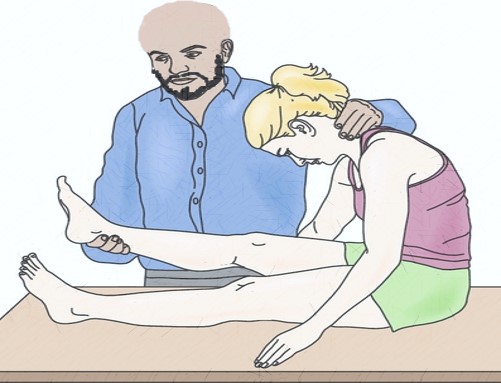
Eliciting Lhermitte’s Sign

lhermittes sign

One patient described it as follows: “When I bent my head, I felt a violent shock in my neck and a pain like an electric current running through my whole body, from the neck down the vertebral column into the feet”. 38. Frederiks JAM. Lhermitte’s sign. In: Koehler PJ, Bruyn GW, Pearce JMS, editors. Neurological eponyms. Oxford: Oxford University Press; 2000. p. 106-10.

Maneuver: Forward flexion of head (actively or passively)

Outcome: Electric sensation spreading from spine into extremities (symmetrical or asymmetrical)

Lhermitte’s sign were elicited also by:

  1. Neck rotation, arm abduction, coughing 4The Sensitive Nervous System By David S. Butler – Neurodynamic testing for Spine and lower limb
  2. Yawning 5Sagiuchi T, Tachibana S, Sato K, et al. Lhermitte sign during yawning associated with congenital partial aplasia of the posterior arch of the atlas. AJNR Am J Neuroradiol2006;27:258–60.

Video for Lhermitte’s Sign

Accuracy of Lhermitte’s Sign

Two studies found that the sensitivity of Lhermitt’s sign is markedly poor, ranging from 3 to 17%. One of these studies also found that it presented good specificity (97%) for nonspecific compressive myelopathy. 6Teive Hélio Afonso Ghizoni, Haratz Salo, Zavala Jorge, Munhoz Renato Puppi, Scola Rosana Hermínia, Werneck Lineu César. Lhermitte’s sign and vitamin B12 deficiency: case report. Sao Paulo Med. J.  [Internet]. 2009  [cited  2016  July  10] ;  127( 3 ): 171-173. Available from: http://www.scielo.br/scielo.php?script=sci_arttext&pid=S1516-31802009000300011&lng=en.  http://dx.doi.org/10.1590/S1516-31802009000300011.

12 shares
  • Facebook12
  • Twitter
Clinical Skills and Approaches Clinical examinationNervous system

Post navigation

Previous post
Next post

Related Posts

Clinical Skills and Approaches

Child with a limp : Mnemonic Approach

Jun 24, 2022Jun 24, 2022

HISTORY AND EXAMINATION Mnemonic: LIMPINGS 1. Limping definition and onset Any deviation in walking pattern away from the expected normal pattern for the child’s age Limping is never normal Acute Acute infections Trauma Leukemia Unstable SCFE Epidural abscess Chronic SCFE DDH Neoplasm Child abuse Neuromuscular conditions Leukemia 2. Injury Mnemonic:…

Read More
Clinical Skills and Approaches

Eliciting Primitive Neonatal Reflexes

Mar 8, 2023Mar 8, 2023

Neonatal reflexes are the reflexes which are present at birth and have a predictable course of appearance and disappearance. A normally developing newborn should respond to certain stimuli with these reflexes, which eventually become inhibited as the child matures. The list of reflexes that can be elicited in normal newborn…

Read More
Clinical Skills and Approaches

Glasgow Coma Scale

Aug 23, 2023Oct 26, 2024

Best eye opening Mnemonic: ESPN Best verbal response Mnemonic: ASWGN Best motor response Mnemonic: OLD BEN Important points Question and Example A 20 year old man is hit over the head with a mallet. On arrival in the accident and emergency department he opens his eyes to pain and groans…

Read More

Leave a Reply Cancel reply

Your email address will not be published. Required fields are marked *

This site uses Akismet to reduce spam. Learn how your comment data is processed.

Pre-clinical (Basic Sciences)

Anatomy

Biochemistry

Community medicine (PSM)

Embryology

Microbiology

Pathology

Pharmacology

Physiology

Clinical Sciences

Anesthesia

Dermatology

Emergency medicine

Forensic

Internal medicine

Gynecology & Obstetrics

Oncology

Ophthalmology

Orthopedics

Otorhinolaryngology (ENT)

Pediatrics

Psychiatry

Radiology

Surgery

RSS Ask Epomedicine

  • What to study for Clinical examination in Orthopedics?
  • What is the mechanism of AVNRT?

Epomedicine weekly

  • About Epomedicine
  • Contact Us
  • Author Guidelines
  • Submit Article
  • Editorial Board
  • USMLE
  • MRCS
  • Thesis
©2026 Epomedicine | WordPress Theme by SuperbThemes