Skip to content
Epomedicine

Mnemonics, Simplified Concepts & Thoughts

Epomedicine

Mnemonics, Simplified Concepts & Thoughts

Glasgow Coma Scale

Epomedicine, Aug 23, 2023Oct 26, 2024

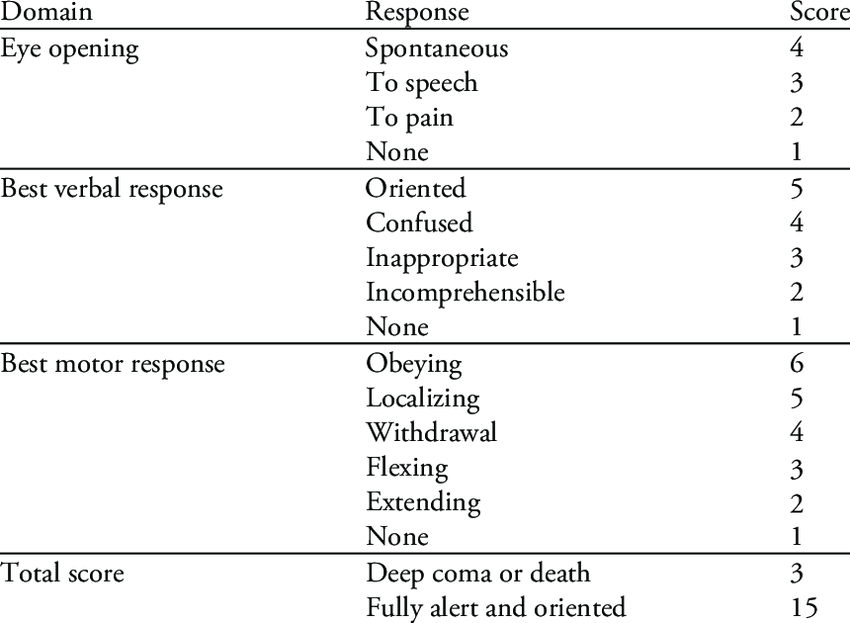
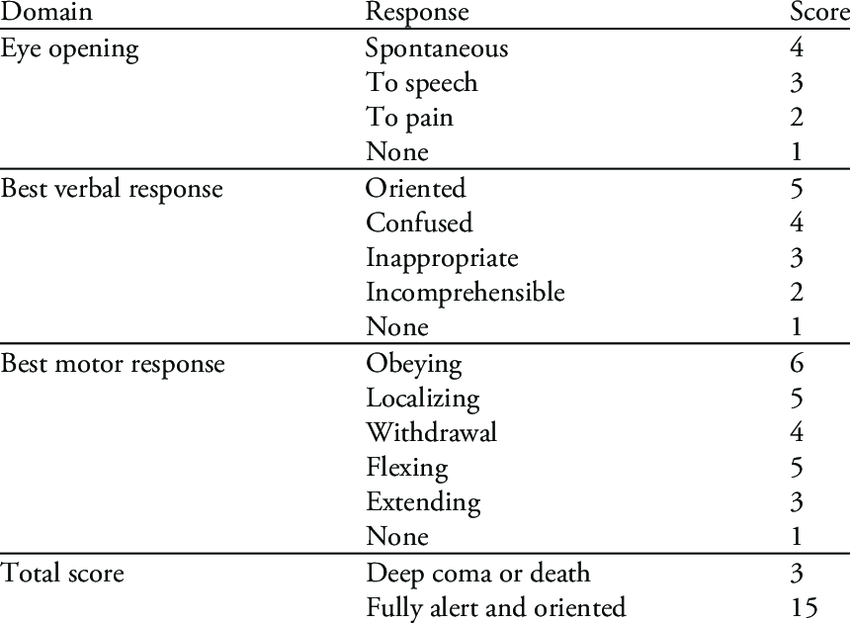
Best eye opening

Mnemonic: ESPN

  • 4 – Eye(s) open spontaneously
  • 3 – to Sounds
  • 2 – to Pain
  • 1 – No opening

Best verbal response

Mnemonic: ASWGN

  • 5 – Appropriate
  • 4 – Sentences (confused)
  • 3 – Words (inappropriate)
  • 2 – Groans and grunts (incomprehensible)
  • 1 – No sound

Best motor response

Mnemonic: OLD BEN

  • 6 – Obeys
  • 5 – Localizes pain
  • 4 – Draws away from pain (withdrawal)
  • 3 – Bends to pain, i.e., decorticate
  • 2 – Extends to pain, i.e., decerebrate (extends elbow to nailbed pressure)
  • 1 – No response
glasgow coma scale

Important points

  1. Minimum score = 3
  2. Maximum score = 15 or 11T (if intubated)
  3. Record best response in each category and sum of all 3. e.g., E3 V3 M4 (10)
  4. “1T” is designated in verbal response for intubated patients. e.g., E3 V1T M4 (8T)
  5. GCS ≤ 8 = Coma
  6. GCS < 8 = Intubate (If less than eight, intubate)
  7. Head injury classification:
    • Mild: GCS 13-15
    • Moderate: GCS 9-12
    • Severe: GCS 3-8
  8. ICP monitoring indications:
    • GCS ≤ 8 after resuscitation + abnormal head CT scan
    • GCS ≤ 8 + normal head CT scan + ≥2 risk factors for intracranial hypertension (including age >40 years, SBP < 90 mmHg, and motor posturing)
  9. CT head indications:
    • GCS <15 at 2 hours following injury
    • GCS <13 at any stage

Question and Example

A 20 year old man is hit over the head with a mallet. On arrival in the accident and emergency department he opens his eyes to pain and groans or grunts. On application of a painful stimulus to his hands, he extends his arm at the elbow. What is his Glasgow coma score?

  • E = Pain (2)
  • V = Groans/grunts (2)
  • M = Extends to pain (2)

So, his GCS is E2 V2 M2 (6).
25 shares
  • Facebook25
  • Twitter
Clinical Skills and Approaches Emergency Medicine Clinical examinationEmergency medicineNervous system

Post navigation

Previous post
Next post

Related Posts

Clinical Skills and Approaches

Modified Ashworth Scale for Spasticity : Mnemonic

May 1, 2022May 1, 2022

Ashworth scale tests resistance to passive motion about a joint with varying degrees of velocity. Modified Ashworth Scale (Bohannon and Smith, 1987) has 1+ grading between grades 1 and 2. Modified Ashworth Scale (Ansari et.al., 2006) has been described here. Mnemonic: Ashworth is a juggling clown 0 : 0 is…

Read More
Clinical Skills and Approaches

Common mistakes in Per Abdominal examination

Jul 31, 2020Jul 31, 2020

1. Forgetting to Expose abdomen adequately: Before examination, patient should ideally be exposed from the nipples to mid thigh. Failure to do so may lead to missed findings during examination e.g. Hernia 2. Abdominal symmetry and movement: Abdominal symmetry and movement should be examined tangentially and from leg end. Comment…

Read More
Emergency Medicine manual detorsion testis

Manual detorsion of testis in Testicular Torsion

Oct 28, 2017Oct 28, 2017

Indications of Manual Detorsion It can serve as a temporizing measure to attempt to reperfuse the testis while the patient is awaiting definite surgical management. Contraindications of Manual Detorsion Manual detorsion is not recommended for torsion of duration >6-8 hours (prolonged ischemia leads to marked swelling and edema after which…

Read More

Leave a Reply Cancel reply

Your email address will not be published. Required fields are marked *

This site uses Akismet to reduce spam. Learn how your comment data is processed.

Epomedicine. Glasgow Coma Scale [Internet]. Epomedicine; 2023 Aug 23 [cited 2025 Dec 6]. Available from: https://epomedicine.com/clinical-medicine/glasgow-coma-scale/.

Pre-clinical (Basic Sciences)

Anatomy

Biochemistry

Community medicine (PSM)

Embryology

Microbiology

Pathology

Pharmacology

Physiology

Clinical Sciences

Anesthesia

Dermatology

Emergency medicine

Forensic

Internal medicine

Gynecology & Obstetrics

Oncology

Ophthalmology

Orthopedics

Otorhinolaryngology (ENT)

Pediatrics

Psychiatry

Radiology

Surgery

RSS Ask Epomedicine

  • What to study for Clinical examination in Orthopedics?
  • What is the mechanism of AVNRT?

Epomedicine weekly

  • About Epomedicine
  • Contact Us
  • Author Guidelines
  • Submit Article
  • Editorial Board
  • USMLE
  • MRCS
  • Thesis
©2025 Epomedicine . All rights reserved.